In this guide
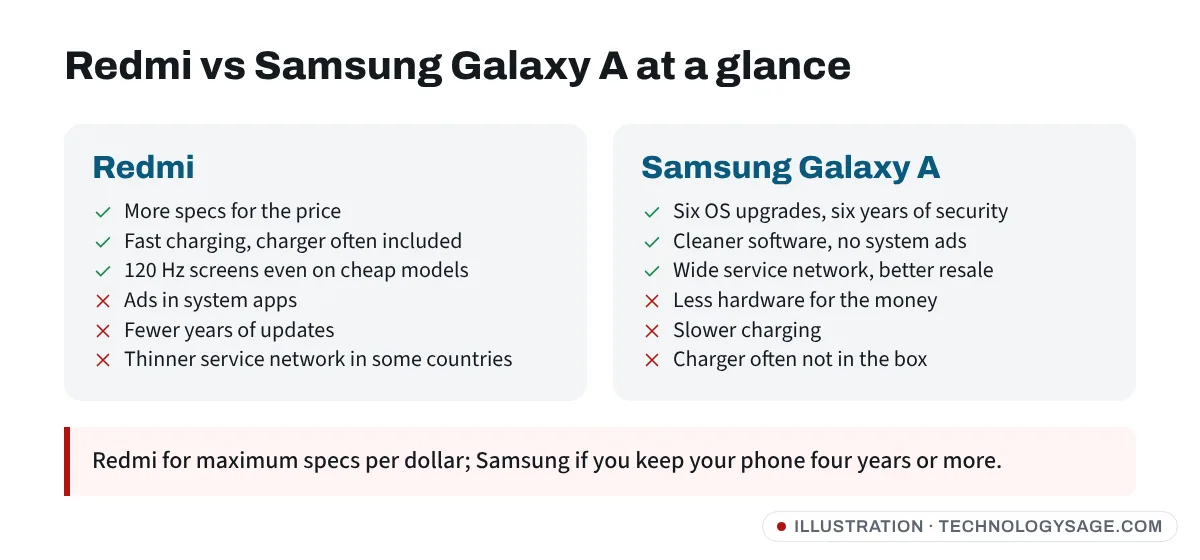
Redmi usually gives you more hardware for the money: bigger batteries, faster charging, smoother screens and more storage at each price. Samsung’s Galaxy A phones give you longer software support, fewer ads in the system and, in many countries, a wider service network and better resale value. If you change phones every two years and want the most specs, Redmi is the better deal; if you keep a phone for four years or more, Samsung is the safer choice.
That’s the short answer. Below is how the two brands compare point by point, which to pick at each budget, and how Redmi stacks up against Infinix.
Price and hardware: Redmi gives more for less
Redmi is Xiaomi’s value brand, and it competes on specs. At the same price as a Galaxy A phone, a Redmi or Redmi Note often has:
- a higher refresh-rate screen (120 Hz is common even on cheap Redmi phones);
- more RAM and storage for the price;
- a bigger battery and much faster charging;
- a charger in the box in most markets, while many Samsung Galaxy A phones now ship without one.
Samsung’s cheapest Galaxy A phones tend to cut corners on charging speed and processor power to hit their price. That gap closes in the mid-range (Galaxy A3x and A5x), where Samsung adds features Redmi often lacks at the same price, such as stronger water resistance on some models and features shared with its flagships.
Software updates: Samsung’s biggest advantage
How long a phone gets Android and security updates decides how long it stays safe to use for banking and mobile money.
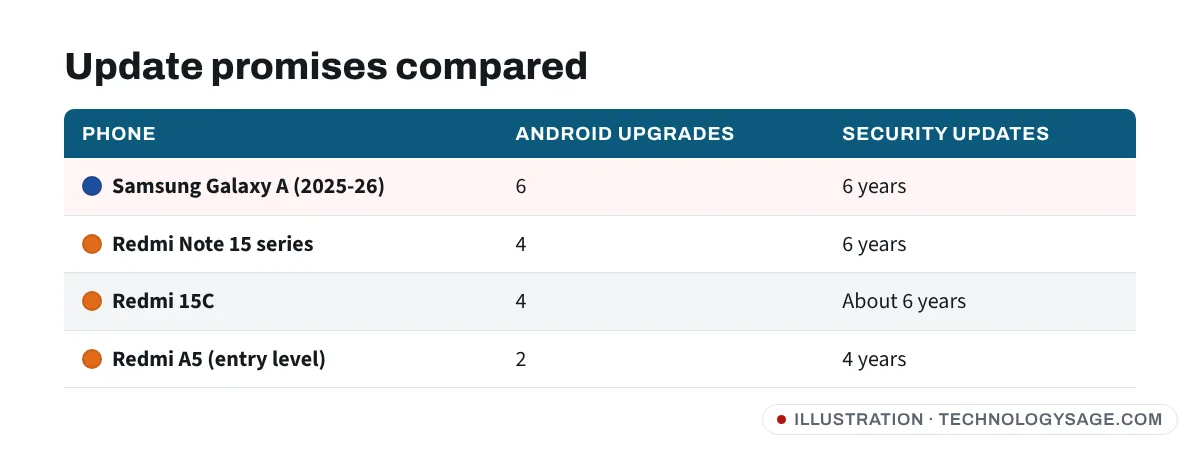
Samsung: recent Galaxy A models, including the Galaxy A07, A17, A26 and A36, are promised six generations of Android upgrades and six years of security updates, according to Samsung. That’s very long for budget phones. Samsung’s store pages note the policy can change, and cheaper models get security updates less often (for example quarterly rather than monthly), but the promise is clear.
Redmi: Xiaomi’s support has improved. The Redmi Note 15 series and some cheaper models like the Redmi 15C are reported to get four Android upgrades and six years of security patches. The cheapest Redmi A-series phones get much less: the Redmi A5, for example, was announced in India with two years of Android updates and four years of security updates. Policies also vary between 4G and 5G versions of the same name.
| Android upgrades | Security updates | |
|---|---|---|
| Samsung Galaxy A (2025-26 models) | 6 | 6 years |
| Redmi Note 15 series | 4 | 6 years |
| Redmi 15C | 4 | about 6 years |
| Redmi A5 (entry level) | 2 | 4 years |
Always check the update policy for the exact model and country before you buy; the brand’s own store or support page lists it.
Ads and preinstalled apps
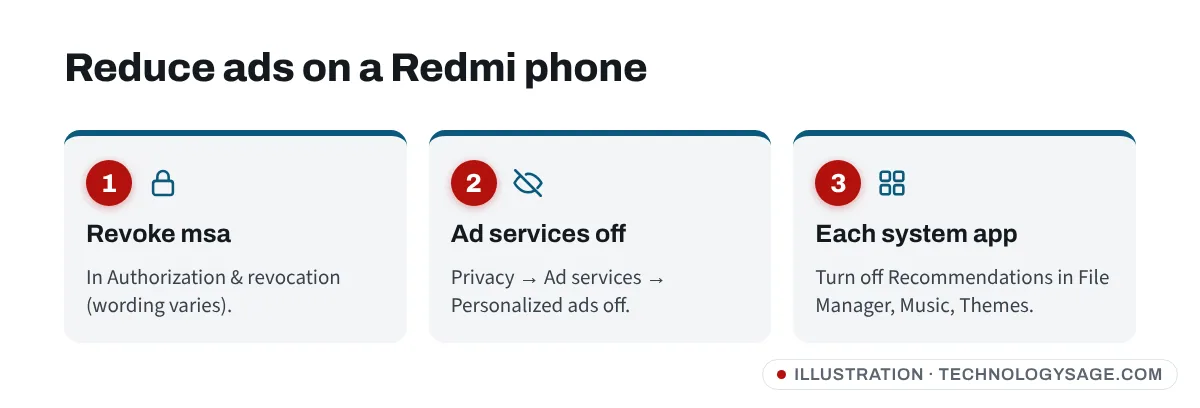
Redmi (HyperOS): Xiaomi’s software shows ads and “recommendations” in several system apps, such as the file manager, music and video players, themes and the app installer screen in some regions. You can reduce them a lot, but there’s no single off switch. The usual steps are:
- Settings → Fingerprints, face data & screen lock → Authorization & revocation (wording varies), then revoke msa.
- Settings → Privacy → Ad services, turn off Personalized ad recommendations. Xiaomi notes this changes which ads you see, not how many.
- Turn off Recommendations in each system app’s settings (File Manager, Music, Themes, Security).
Samsung (One UI): Galaxy A phones come with some preinstalled apps and occasional promotional notifications from Samsung apps, but you don’t get ads inside the settings or file manager. Most extra apps can be uninstalled or disabled, which also helps an older phone feel quicker (see how to make your Android run faster).
If ads and clutter bother you, this point alone often decides it in Samsung’s favour.
Cameras
In daylight, Redmi and Samsung phones at the same price take similar photos. Don’t judge by megapixels; a 200 MP or 108 MP main camera doesn’t guarantee better pictures. In general:
- Samsung tends to give consistent colours, decent video and a good selfie camera, with the same camera app as its flagships.
- Redmi often has a strong main camera for the price, but the extra ultra-wide and macro cameras on cheaper models are usually low quality.
If camera matters most, compare sample photos for the exact two models you’re considering, especially at night.
Battery and charging
Redmi phones usually charge much faster. Many Redmi Note models support 33 W to 120 W charging (depending on the model) with the charger included, while most Galaxy A phones top out at 25 W or 45 W and may ship without a charger. Battery life on a full charge is broadly similar for similar battery sizes.
Whichever you choose, battery health matters more than brand after two years; here’s how to check battery health on Android.
Durability and build
- Water resistance: Samsung’s Galaxy A3x and A5x models carry IP67 ratings, and some recent Redmi Note Pro models advertise IP68 or higher. Cheaper models from both brands usually have only splash resistance or none.
- Screens: both use Gorilla Glass on many mid-range models; entry-level models often use cheaper glass. Use a case and screen protector either way.
- Long-term reliability: both brands have had batch-specific problems (screen, motherboard or charging-port faults) on individual models. Read reviews and owner forums for the exact model rather than trusting brand reputation.
Service, warranty and resale
- Service centres: Samsung has official service centres in most countries, including across Africa and South Asia. Xiaomi’s service network is strong in India and growing elsewhere, but in some African countries it’s thinner than Samsung’s (and thinner than Carlcare for Tecno and Infinix).
- Parts: Samsung parts are easy to find; for Redmi, availability depends on how popular the model is locally.
- Resale: Samsung phones generally hold their value better second-hand, which partly offsets their higher price.
Which should you buy at each budget?
| Budget (approx.) | Redmi | Samsung | Pick |
|---|---|---|---|
| Under $120 | Redmi A series | Galaxy A0x | Samsung for updates; Redmi for screen and battery |
| $120-$250 | Redmi / Redmi Note | Galaxy A1x / A2x | Redmi for specs; Samsung if you keep phones 4+ years |
| $250-$400 | Redmi Note Pro | Galaxy A3x / A5x | Close; Samsung for updates and water resistance |
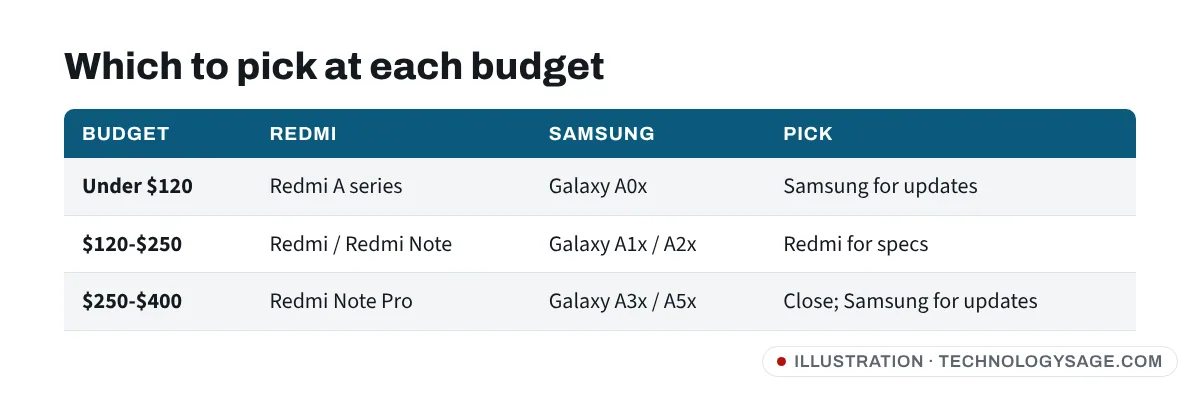
Prices vary a lot by country, so compare the actual models available to you. For more options, see our list of the best budget smartphones.
Choose Redmi if: you want the most screen, storage, battery and charging speed for your money, you’re comfortable spending ten minutes switching off ads, and you replace your phone every two to three years.
Choose Samsung if: you keep phones for four years or more, use mobile money or banking apps and want security updates for longer, want cleaner software, or want easy access to official repairs.
Redmi vs Infinix
Infinix (part of Transsion, alongside Tecno and itel) competes directly with Redmi in Africa, South Asia and Southeast Asia.
- Price and specs: very close. Infinix often adds big batteries, fast charging and bright displays at low prices, much like Redmi.
- Updates: Redmi generally promises more years of updates than Infinix’s budget phones. Check the exact model.
- Ads and preinstalled apps: both XOS (Infinix) and HyperOS (Redmi) come with extra apps and promotional content; both can be cleaned up.
- Service: in much of Africa, Infinix has the advantage through the Carlcare service network.
We cover Transsion’s brands in more depth in is Infinix a good brand? and Tecno vs Infinix.
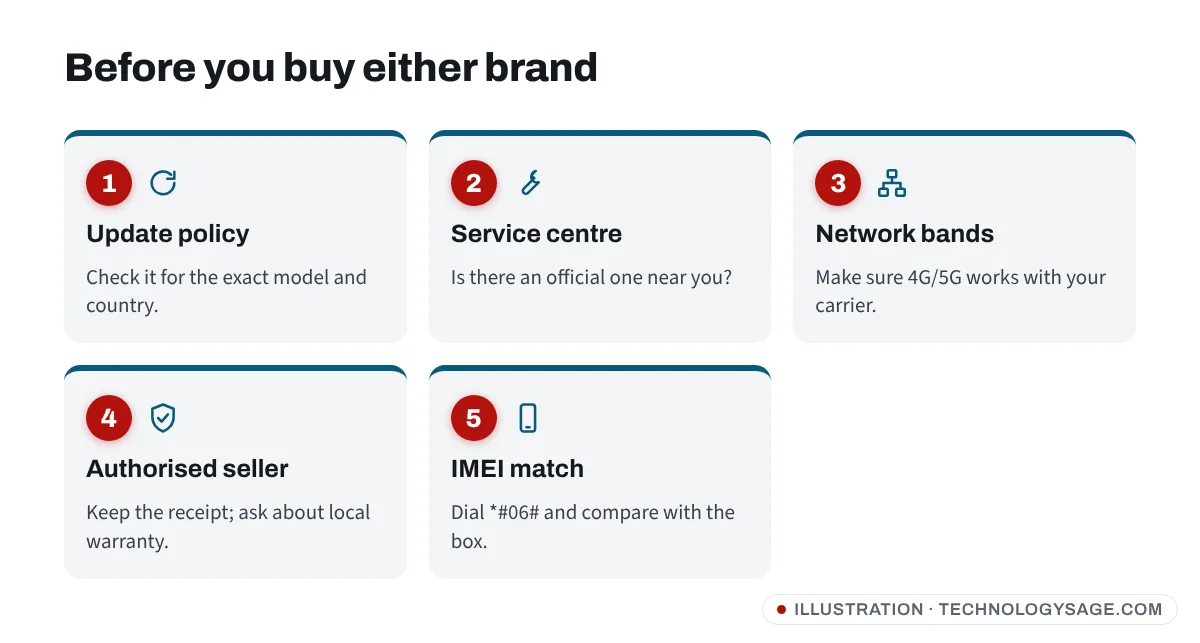
Before you buy: quick checklist
- Check the update policy for the exact model on the brand’s website.
- Check for an official service centre near you.
- Confirm the network bands (4G/5G) work with your carrier, especially for imported phones.
- Buy from an official store or authorised dealer and keep the receipt; ask whether the warranty is local.
- Check the IMEI on the box matches the phone (dial *#06#).
FAQ
Is Redmi better than Samsung?
For specs at a given price, usually yes. For long-term software support, fewer ads and service, Samsung is usually better. The right choice depends on how long you keep your phone.
Which lasts longer, Redmi or Samsung?
Samsung’s recent Galaxy A phones are promised six years of security updates, more than most Redmi models get. Physical lifespan depends more on the specific model and how you treat it.
Do Samsung phones have ads like Redmi?
Much less. Samsung includes some preinstalled apps and occasional promotional notifications, but not ads inside system apps like the file manager. Redmi’s ads can be reduced through settings.
Is Redmi a Chinese brand?
Yes, Redmi is a sub-brand of Xiaomi, based in China. Samsung is a South Korean company. Both sell phones made in several countries, including India and Vietnam.
Redmi or Samsung for gaming?
At the same price, Redmi often has a faster processor and screen. For heavy gaming on a budget, Redmi (or Xiaomi’s Poco brand) usually gives more performance per dollar.