In this guide
DeepSeek is safe in the sense that the official app isn’t malware, but it carries a privacy risk you should understand before using it. Its privacy policy (updated 10 February 2026) says it collects your prompts, uploaded files and chat history along with device and network data, and stores it in the People’s Republic of China. That’s why regulators in Italy, South Korea and Germany acted against the app, and several governments banned it on official devices. For everyday questions with nothing personal in them, the risk is low; for anything private, work-related or sensitive, use another assistant or run DeepSeek’s open model on your own device.
What is DeepSeek?
DeepSeek is a Chinese AI company whose free chatbot (the DeepSeek app and chat.deepseek.com) shot to the top of app store charts in many countries in January 2025. It’s good at maths, coding and reasoning and is free to use. DeepSeek also publishes open-weight models that anyone can download and run on their own computer, which matters for privacy (see below).
What DeepSeek’s privacy policy says
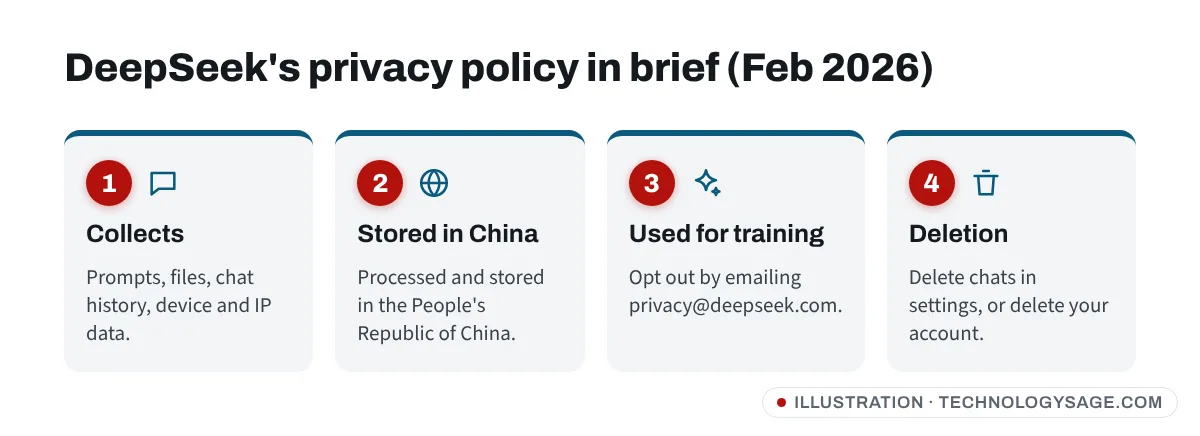
From DeepSeek’s privacy policy, last updated 10 February 2026:
- What it collects: your account details (email or phone number, date of birth where applicable), everything you type or say, files and photos you upload, chat history, device model and operating system, IP address, device identifiers, crash logs, and approximate location from your IP address.
- Where it’s stored: DeepSeek says it collects, processes and stores data directly in the People’s Republic of China.
- Training: your inputs can be used to train and improve its models. The policy says you can opt out by emailing [email protected]; there’s no simple switch for this described in the policy.
- Retention: data is kept as long as you have an account.
- Deletion: you can delete chat history in the app’s settings and delete your account permanently. Other requests go to the privacy email.
- Sensitive data: the policy asks you not to submit sensitive personal information, and says it doesn’t extract voiceprints or facial data.
Compared with US chatbots, the big difference is the location. Critics point to Chinese laws that can require companies to share data with authorities on request, and EU regulators have questioned whether DeepSeek’s transfers meet European data-protection rules.
What regulators have done
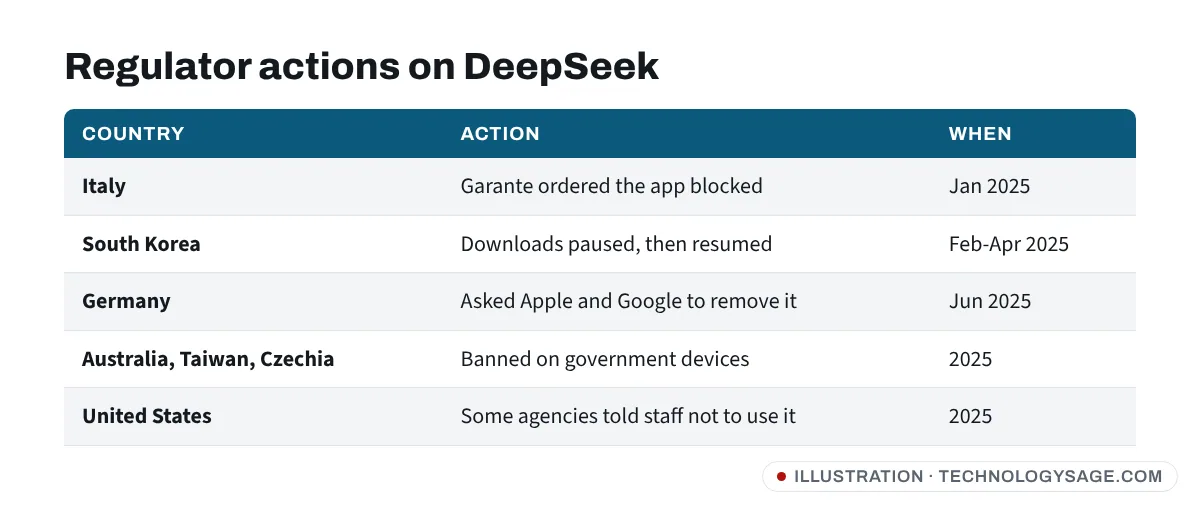
| Country | Who | What happened |
|---|---|---|
| Italy | Data protection authority (Garante) | Ordered DeepSeek blocked in Italy in January 2025 after unsatisfactory answers about how it handles personal data |
| South Korea | Personal Information Protection Commission | Suspended new downloads from 15 February 2025; found the app had sent user data to other companies without proper consent; downloads resumed in late April 2025 after changes |
| Germany | Berlin data protection commissioner | Asked Apple and Google in June 2025 to remove DeepSeek from German app stores, saying data was transferred to China unlawfully |
| Netherlands, France | Privacy regulators | Questioned DeepSeek about its data collection in early 2025; the Dutch regulator opened an investigation |
| Australia, Taiwan, Czech Republic, Netherlands | Governments | Banned or restricted DeepSeek on government devices or for public officials in 2025 |
| United States | Federal agencies including NASA and defence departments | Told staff not to use it; no nationwide ban for the public |
| India | Finance ministry | Advised staff not to use AI tools including DeepSeek for official work |
Most of these actions date from 2025. As of November 2026 we couldn’t find a new nationwide ban for ordinary users; DeepSeek remains available in most countries. Check your own country’s data protection authority for current guidance.
Security problems found so far
- In January 2025, the cloud security company Wiz reported finding a DeepSeek database exposed on the internet with chat history and other sensitive information. DeepSeek secured it quickly after being told.
- South Korea’s regulator found that the app had transferred user information and prompts to third parties during its launch, which DeepSeek stopped in April 2025.
These were serious but fixed. They’re a reminder not to type anything into any chatbot that you couldn’t afford to leak.
Censorship and accuracy
DeepSeek’s app follows Chinese content rules, so it avoids or gives the official line on politically sensitive topics about China. Like all chatbots, it can also state wrong facts confidently. Italy’s competition authority investigated DeepSeek for not warning users clearly enough about these “hallucinations” and closed the case after DeepSeek made commitments.
How to use DeepSeek more safely
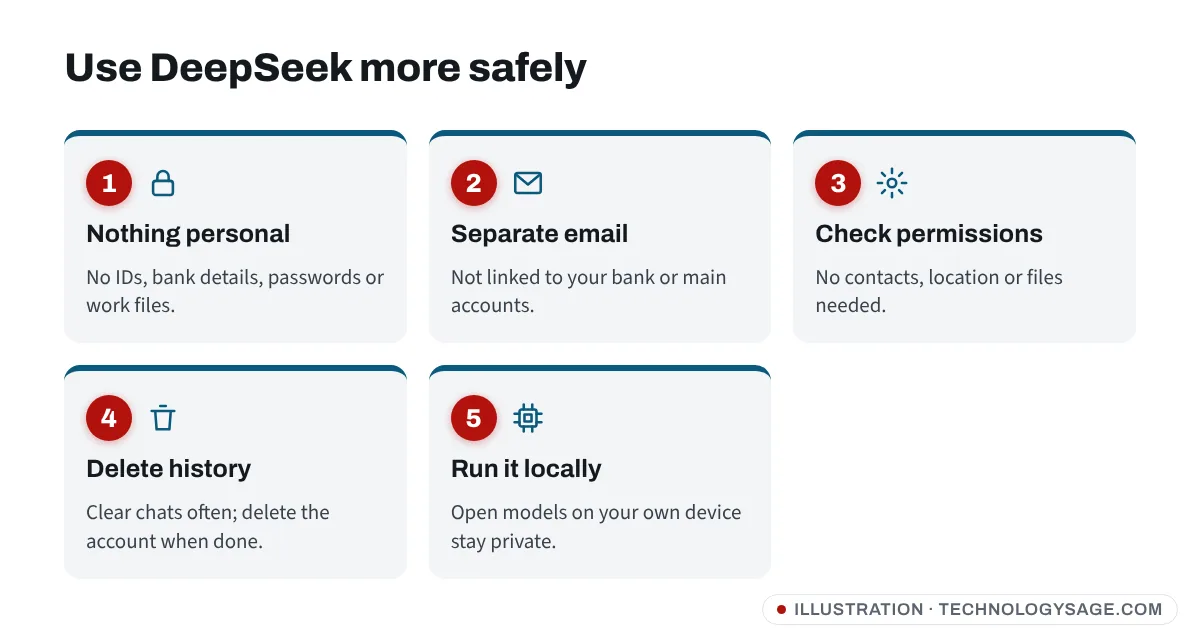
- Share nothing personal. No ID numbers, bank details, passwords, OTP codes, health information, client data or work documents. This applies to every AI chatbot.
- Use a separate email that isn’t linked to your banking or main accounts, and a strong, unique password.
- Use the website (chat.deepseek.com) instead of the app if you want to limit the device data collected.
- Check app permissions: Settings → Apps → DeepSeek → Permissions. It doesn’t need contacts, location or files for normal chat.
- Delete your chat history regularly in the app’s settings, and delete your account when you stop using it.
- Opt out of training by emailing [email protected], as the policy describes.
- Install only the official app (developer: DeepSeek) from the Play Store or App Store. Fake “DeepSeek” apps and “DeepSeek Pro APK” downloads have circulated since 2025.
- Don’t use it for work if your employer or government role has banned it.
The most private option: run DeepSeek’s model yourself
Because DeepSeek’s models are open-weight, you can run smaller versions on your own phone or laptop with apps like PocketPal AI, Ollama or LM Studio. Then your chats never leave your device, and DeepSeek’s servers aren’t involved at all. Our guide on using AI offline shows how. Some other companies also host DeepSeek models on their own servers, in which case that company’s privacy policy applies instead.
DeepSeek vs ChatGPT
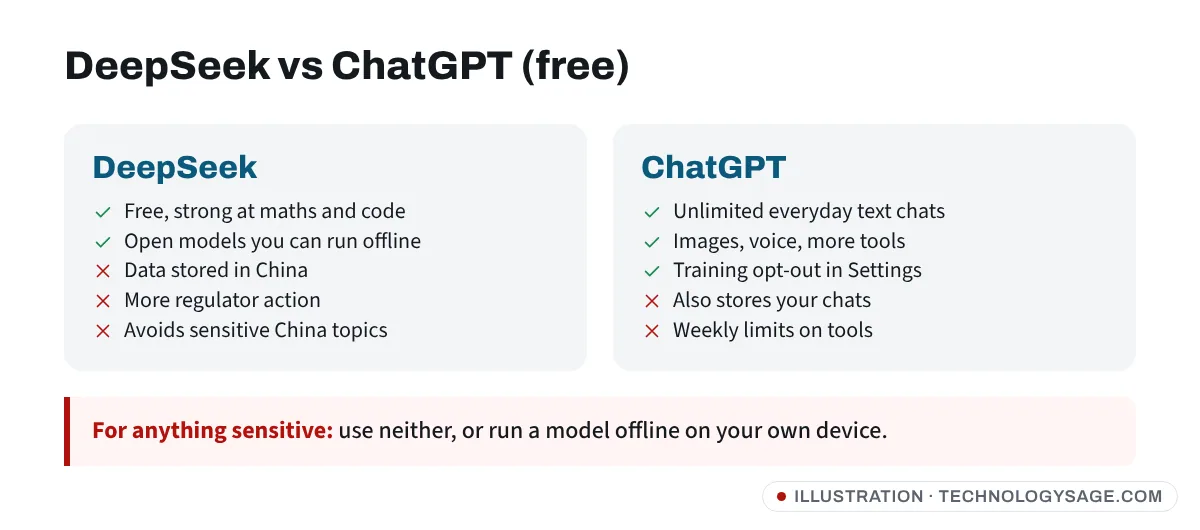
- Free use: both are free. ChatGPT’s free plan has no cap on everyday text chats as of November 2026 (ChatGPT free limits).
- Data location: DeepSeek stores data in China; OpenAI is a US company, and its free chats are also used for training unless you opt out in Settings → Data controls.
- Features: ChatGPT has image creation, voice and more tools; DeepSeek focuses on text, reasoning and code.
- Regulation: DeepSeek has faced more regulatory action, especially in Europe and South Korea.
For more options, see our best free AI chatbot comparison.
Safety note: whichever AI you use, scammers copy popular brands. No real AI company asks you to pay by gift card or airtime, or asks for your password or a verification code. If you’ve entered your details into a fake app, change your passwords now; our guide on changing your Gmail password helps, and our older guide on free VPN safety covers another app category where “free” often costs your data.
FAQ
Is DeepSeek safe to download?
The official app from the Play Store or App Store isn’t malware. The concern is privacy: what you type is stored in China. Avoid unofficial APKs, which can be.
Is DeepSeek banned?
Not for the general public in most countries. Italy’s regulator ordered it blocked, South Korea paused downloads for about two months in 2025, Germany asked app stores to remove it, and several governments banned it on official devices.
Does DeepSeek steal your data?
It collects a lot of data, as described in its privacy policy, and stores it in China. That’s a legal and privacy risk rather than theft, but it’s why you shouldn’t share anything sensitive.
Can I use DeepSeek without an account?
The app and website require you to sign in. To use DeepSeek’s models with no account and no data leaving your device, run an open-weight version locally.
Is DeepSeek safer than ChatGPT?
Not for privacy. Both collect your chats, but DeepSeek stores them in China and has faced more regulatory action. For anything sensitive, use neither, or run a model offline.