In this guide
AI detectors flag human writing because they don’t actually know who wrote something. They guess from patterns: text that is plain, predictable and evenly structured looks “AI-like” to them, and that describes a lot of careful student writing, especially by people writing in their second or third language. If you’ve been flagged for work you wrote, stay calm, ask to see the report, and show your writing process: Google Docs or Word version history, drafts, notes and sources. A detector score alone is not proof.
This guide is for people who wrote their own work. If you used AI where it wasn’t allowed, the honest move is to say so early; most institutions treat that very differently from denial.
Why detectors get it wrong
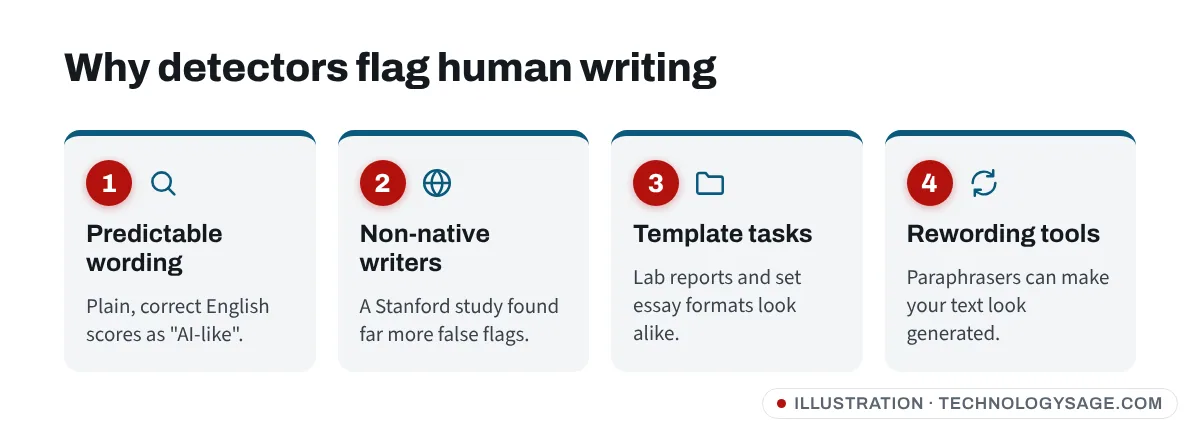
- They measure predictability, not authorship. Many detectors score how “surprising” each word choice is. Simple, correct, formal English is predictable, so it scores as AI.
- Non-native English writers are flagged more. A Stanford study (“GPT detectors are biased against non-native English writers”, 2023) found that seven popular detectors were near-perfect on essays by US eighth-graders but labelled over half of TOEFL essays by non-native speakers as AI-generated, with an average false-positive rate of 61%.
- Formulaic assignments look alike. Lab reports, literature reviews, cover letters and five-paragraph essays follow templates, and so does AI.
- Grammar and rewording tools change your text. Tools that rewrite sentences (paraphrasers, “improve writing” buttons, some Grammarly and Word features) can make human text look machine-made.
- Even the makers admit limits. OpenAI shut down its own AI text classifier in July 2023 because of its “low rate of accuracy”. Turnitin says its detector can produce false positives, doesn’t show a number for scores between 1% and 19% (it shows an asterisk instead) to reduce them, and tells teachers the score should start a conversation, not decide a case.
Is ZeroGPT, GPTZero or Turnitin accurate?
No detector is accurate enough to prove misconduct on its own. Results can change if you paste the same text twice, add a heading or fix a few commas, and different detectors often disagree completely about the same essay. Free web detectors are generally less tested than the ones universities license. That’s why many universities’ own guidance says AI detection should never be the only evidence.
What to do if you’ve been flagged
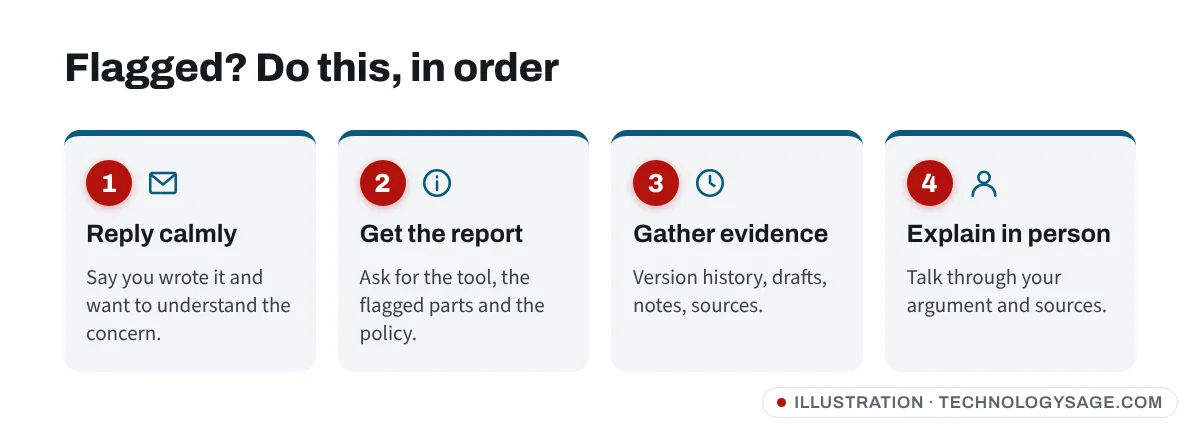
- Don’t panic, and don’t argue in an angry email. Reply politely that you wrote the work yourself and would like to understand the concern.
- Ask for the specifics: the report or score, which parts were flagged, which tool was used, and your institution’s academic integrity policy and appeal process.
- Gather your evidence (next section). Do this before any meeting.
- Write a short statement: when you started, how you researched, which tools you used (spell checker, Grammarly, translation, AI for brainstorming if allowed) and how you wrote it.
- Offer to explain your work in person. Being able to talk through your argument, sources and choices is strong evidence you wrote it.
- Ask for support if it goes to a formal hearing: a student union or students’ representative council, an academic adviser, or a trusted lecturer.
How to prove you wrote it: version history
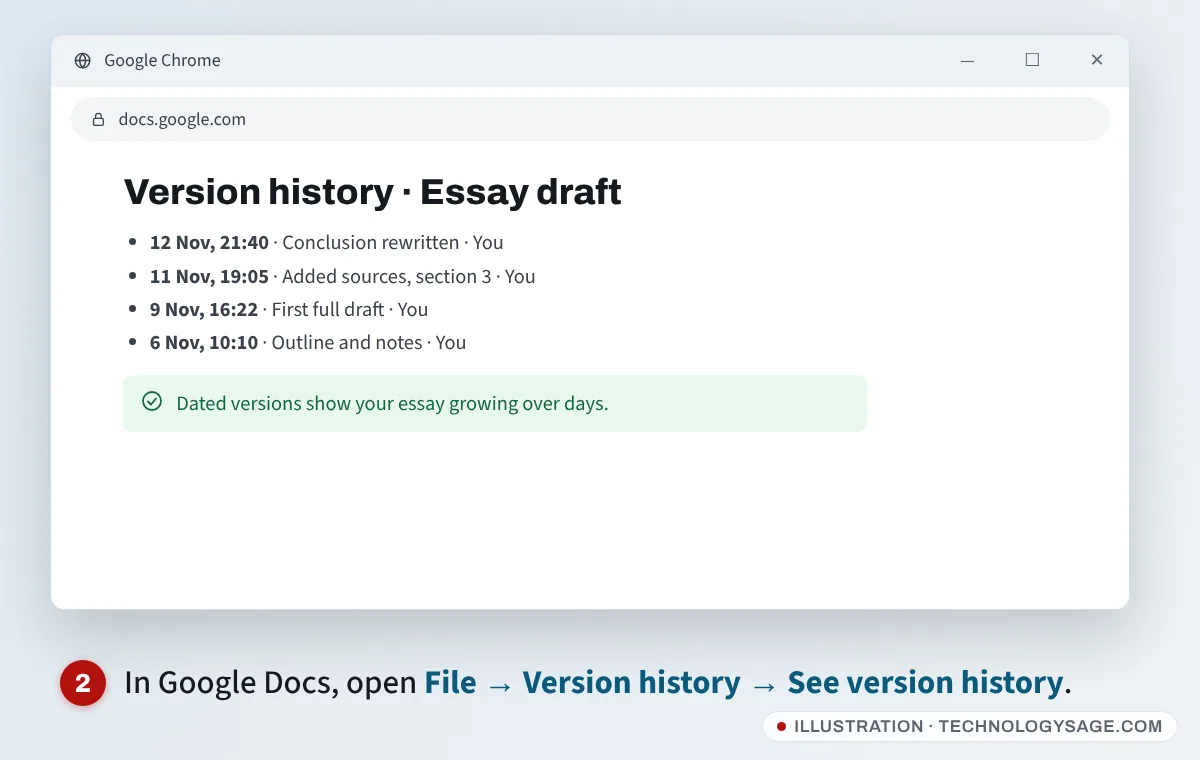
Version history is the best evidence most students have, because it shows your work growing over days, with typos, deletions and rewrites, which is how people write.
Google Docs
- Open the document on a computer (the full history isn’t shown in the phone app).
- Click File → Version history → See version history (or press Ctrl + Alt + Shift + H).
- You’ll see dated versions down the right. Click Expand to see smaller edits.
- Take screenshots that show the dates and the text changing, or share the document with your lecturer with Commenter access so they can view the history.
Microsoft Word
- Version history works for files saved in OneDrive or SharePoint.
- Open the file and go to File → Info → Version History (in Word for the web, File → Info → Previous versions).
- Open older versions to show how the work developed.
If you wrote in a phone notes app or offline Word file, version history may not exist, but other evidence still helps.
Other evidence that helps
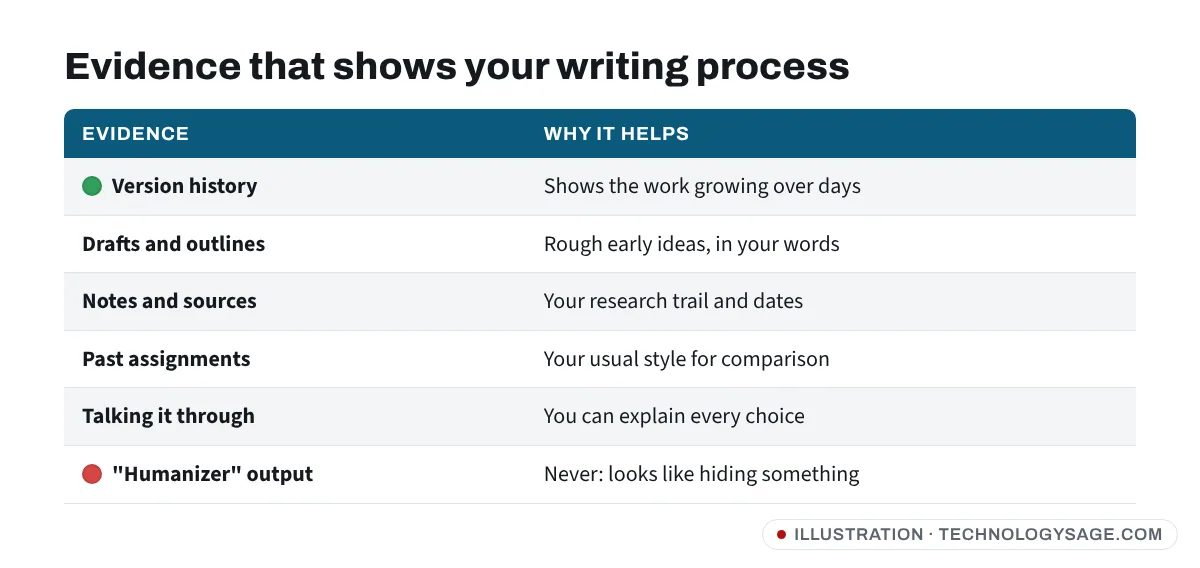
- Earlier drafts and outlines, even rough ones, and saved copies with dates.
- Handwritten notes or photos of notes, with their timestamps.
- Your sources: downloaded PDFs, library records, browser history showing your research on the days you worked.
- Feedback you received, such as emails with a tutor or comments from a friend.
- Your past work, so the marker can compare your usual style.
- Your file’s details: “created” and “modified” dates (right-click the file → Properties on Windows).
How to protect yourself next time
- Write in Google Docs or Word saved to OneDrive, so version history is automatic.
- Keep notes, outlines and drafts until your grade is final.
- Check your course’s AI policy and stick to it. If AI use is allowed for brainstorming or grammar, say how you used it in a short note at the end.
- Be careful with rewording tools. Accepting a whole paragraph of “improved” text makes it less yours and more likely to be flagged.
- Don’t use “AI humanizer” tools. They rewrite your text into stranger English, can still be detected, and look like an attempt to hide something if discovered. Your real process is better protection.
- Use your own voice: specific examples, your own opinions, class discussions and local context are hard for anyone to mistake for generic AI text.
For the basics of building your own argument, our older guides on writing a research paper and writing an analytical essay still apply, and the consequences of plagiarism explains why integrity cases are taken seriously.
FAQ
Can an AI detector prove I used ChatGPT?
No. Detectors estimate likelihood from patterns and are known to make mistakes. Even Turnitin says its score shouldn’t be used as the only basis for action against a student.
Why does Turnitin show an asterisk instead of a percentage?
Turnitin hides scores between 1% and 19% and shows an asterisk, because low scores are more likely to be false positives.
I’m not a native English speaker. Am I more likely to be flagged?
Research suggests yes. Simpler vocabulary and textbook grammar look predictable to detectors. Mention this in your statement and point your institution to the Stanford research.
Should I run my essay through a detector before submitting?
It can’t prove anything either way, and free detectors give inconsistent results. Spend the time keeping good version history and drafts instead.
Is using Grammarly or a translator considered AI use?
It depends on your institution’s policy. Basic spelling and grammar checks are usually fine; tools that rewrite or generate text may not be. Ask your lecturer and disclose what you used. If you’re a student looking for AI tools you can use legitimately, see Gemini for students.