

In this guide
Yes, Temu is legit in the sense that matters most: it’s a real marketplace owned by PDD Holdings, a large Nasdaq-listed company, and most orders do arrive and can be refunded through its 90-day Purchase Protection program. But “legit” isn’t the same as “no downsides”. Expect slow or uneven delivery on some items, quality that matches the price, sizing that runs small, and a data-collection record that several US states and the European Commission have taken action over.
Below is what Temu is, why it’s so cheap, how refunds really work, what regulators have actually alleged (with dates), the scams that use Temu’s name, and how to order safely. Facts are as of November 2026.
Who owns Temu, and is Temu Chinese?
Temu is owned by PDD Holdings Inc., the company that also runs Pinduoduo, one of China’s biggest shopping apps. Pinduoduo was founded in Shanghai in 2015 by Colin Huang, and the parent company has been listed on the Nasdaq (ticker PDD) since 2018.
So is Temu Chinese? Its roots are. PDD has listed Dublin, Ireland as its principal executive office since 2023, and Temu’s US business is operated by a US subsidiary, Whaleco Inc., but the company grew out of China, much of its engineering and management sits there, and most products are made by Chinese manufacturers and sellers. Temu launched in the US in September 2022 and then expanded to the UK, Canada, Australia, New Zealand, Ireland and dozens of other countries.
How is Temu so cheap?
There’s no single trick. The main reasons:
- Factory-direct selling. Many listings come straight from manufacturers, skipping importers, wholesalers and retail markups.
- Huge scale and thin margins. PDD runs the same model in China and spends heavily on marketing and discounts to win customers.
- Cheap shipping rules (until 2025). In the US, small parcels worth $800 or less used to enter duty-free under the “de minimis” rule. The US ended that for China and Hong Kong on 2 May 2025 and for all countries on 29 August 2025. Temu responded by moving many US listings to local warehouses, and some prices rose.
- Lower-cost products. Many items are unbranded and made to a price, which is where quality complaints come from.
The UK, EU, Canada and Australia have their own import rules and taxes, so the checkout price (and whether VAT or GST is included) differs by country.
Temu’s refund policy and Purchase Protection
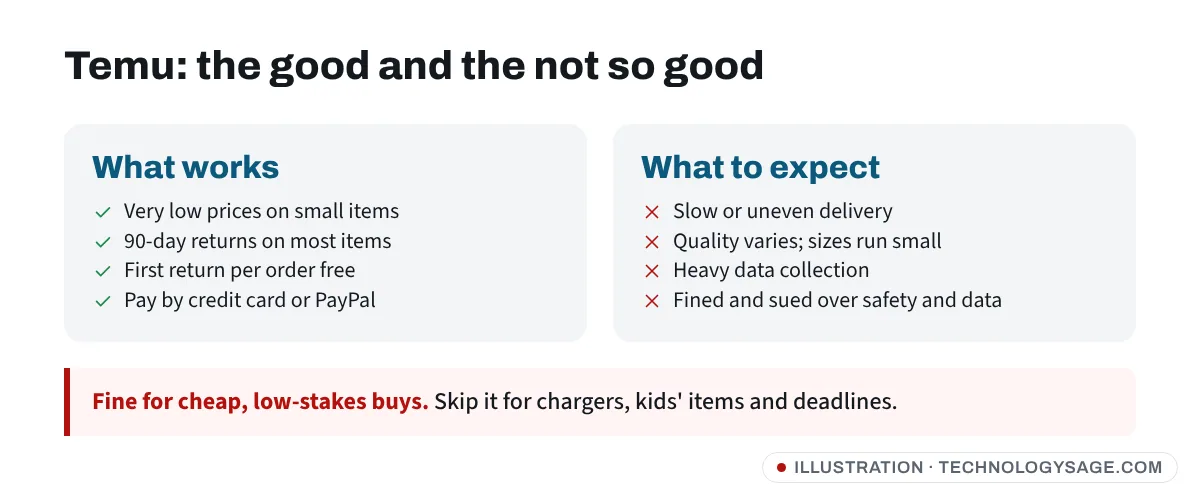
Temu’s official Purchase Protection page says:
- 90-day returns: “The return window for most items is 90 days from the date of purchase.” Some items can’t be returned, so check the listing and the policy exceptions before you buy.
- Free first return: you get one free return per order, which can include several items.
- Damaged, wrong or missing items: covered if the item doesn’t match its description or photos, arrives damaged, or is lost or delayed in transit.
- Refund method: you choose Temu credit (usually faster) or your original payment method.
- Late delivery: Temu gives a credit to your Temu balance if an order arrives after the latest promised date; the amount depends on your country.
To start a return, open the app or temu.com, go to Your orders, pick the order and tap Return/Refund. Temu notes that a refund may be less than the item’s listed price, because coupons, credit and shipping are taken into account.
In the UK and EU, Temu describes the 90 days as extra protection on top of your legal rights (such as the 14-day cooling-off period for online orders), not a replacement for them.
Common Temu complaints
Most complaints about Temu are about expectations, not fraud:
- Delivery times. Local-warehouse items can arrive in a few days; items shipped from overseas often take one to two weeks or longer, and tracking can sit still for days.
- Quality. Cheap electronics, chargers, cosmetics and kids’ items get the most criticism. Treat anything that plugs in, touches your skin or goes to a child with extra care.
- Sizing. Clothing often runs one or two sizes small. Use the size chart in centimetres or inches, not the S/M/L label.
- Photos vs reality. Listing photos can be heavily edited. Customer photos in reviews are more reliable.
- Refund friction. Some buyers report refunds being slow or issued as credit when they wanted money back. Choosing “original payment method” and keeping screenshots helps.
Data and privacy concerns: what regulators alleged
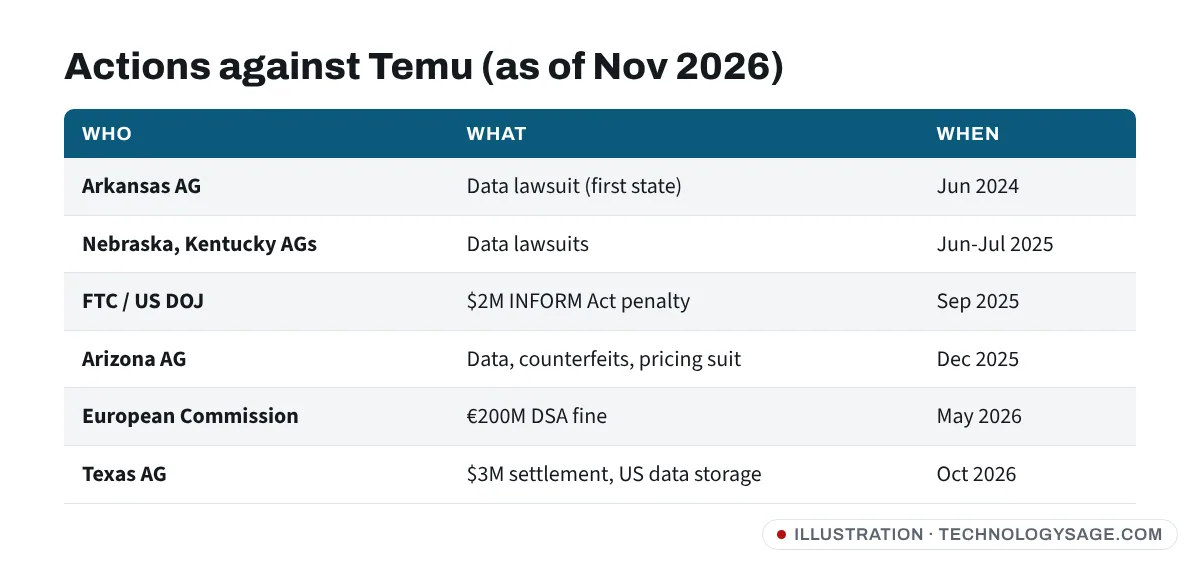
This is where opinions get loud, so here’s what’s on the public record. Allegations are allegations; Temu has denied them in each case.
- Grizzly Research report (September 2023). A short seller that held a bet against PDD’s stock published a report calling the Temu app “spyware”. Temu rejected it. Separately, in March 2023 Google suspended the Pinduoduo app (not Temu) from Google Play after finding malware in versions distributed outside the store.
- Arkansas (June 2024). The first state lawsuit, filed by Attorney General Tim Griffin, alleged the app collects far more data than a shopping app needs.
- Nebraska (June 2025) and Kentucky (July 2025). Both attorneys general filed similar lawsuits over data collection, with Nebraska also raising concerns about children’s data.
- FTC and Justice Department (September 2025). Temu’s US operator agreed to a $2 million civil penalty in the first case under the INFORM Consumers Act, which requires marketplaces to show seller details and give buyers a way to report suspicious listings. Temu didn’t admit the allegations.
- Arizona (December 2025). Attorney General Kris Mayes sued Temu and PDD over alleged data collection without consent, counterfeit goods and misleading “reference prices”.
- European Commission (May 2026). After an investigation opened in October 2024, the Commission fined Temu €200 million under the Digital Services Act for failing to properly assess the risk of illegal products, such as unsafe baby toys and chargers, reaching EU buyers. Temu said it disagrees with the decision.
- Oklahoma (May 2026) and Iowa have also sued.
- Texas (October 2026). Texas settled its February 2026 lawsuit for $3 million, with Temu agreeing to store Texans’ data on US servers, restrict access from China and test products for harmful substances. Temu admitted no wrongdoing.
As of November 2026, we found no court ruling against Temu on the merits of the spyware claims; the cases have either settled or are still going. The practical takeaway: Temu collects a lot of data, its parent is subject to Chinese law, and several governments are uneasy about that. If that bothers you, shop on the website in a browser instead of installing the app, as with DeepSeek and other Chinese-owned apps.
Fake Temu sites and “free gift” scams
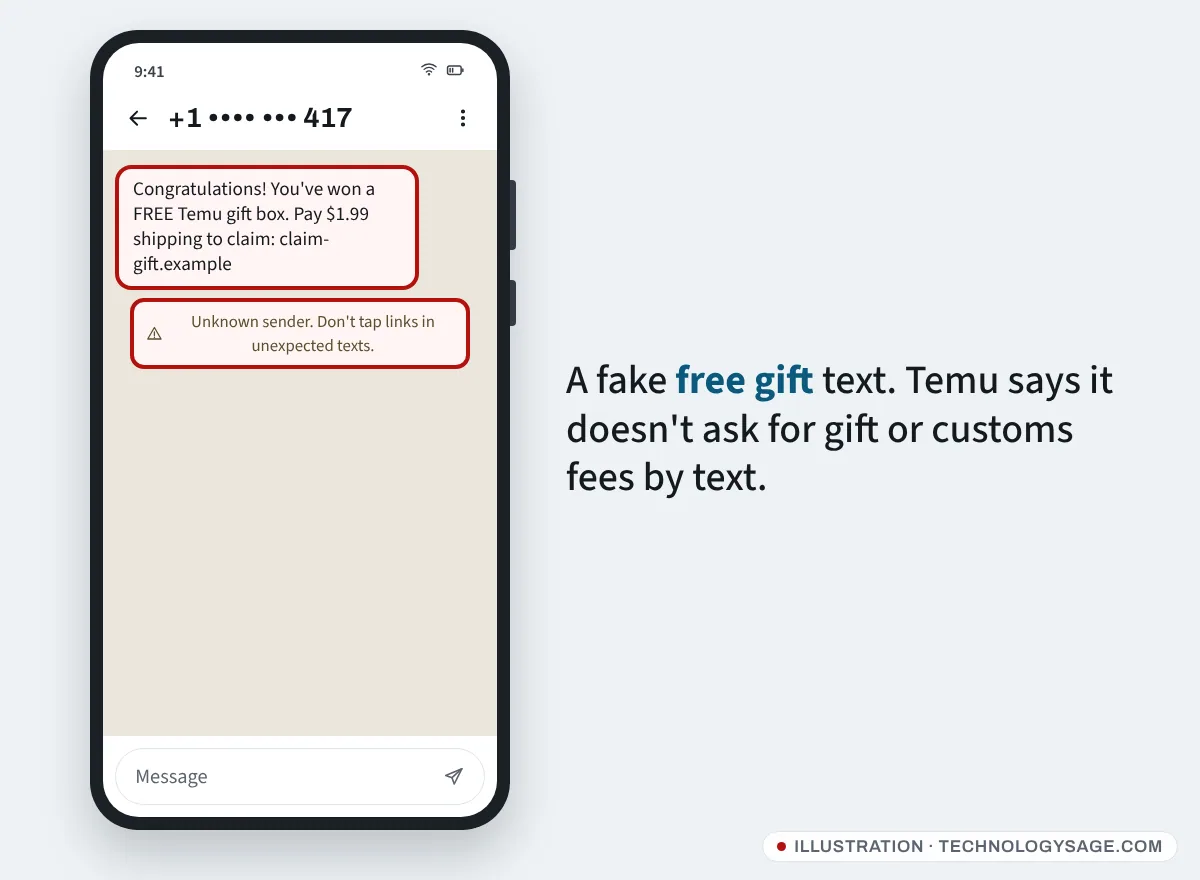
A lot of “Temu scams” have nothing to do with Temu itself. Criminals borrow its name because it’s popular:
- Lookalike websites with names like “temushoppings.com” (a real example reported by security researchers) that copy the design, take your card and ship nothing.
- “Free gift” and “you’ve won” texts that ask you to pay a small “shipping” or “customs” fee. Temu’s phishing help page says it won’t ask you to pay extra fees for a free gift or customs clearance by email or text.
- Fake delivery texts with a tracking link that leads to a login page that steals your Temu password.
- Fake job offers (“earn $300 a day reviewing Temu products”) that end in a request for money or crypto.
- Sellers who ask you to pay off the site by wire transfer, QR code or e-wallet. Real Temu orders are only paid at Temu’s own checkout.
Temu lists its genuine email domains on that help page (for example temu.com and temuemail.com) and asks you to forward suspicious messages to [email protected]. When in doubt, don’t tap the link: open the Temu app or type temu.com yourself and check Your orders. Like any big site, Temu also uses trackers and cookies; our guide to how websites track you explains what you can switch off.
How to buy on Temu safely
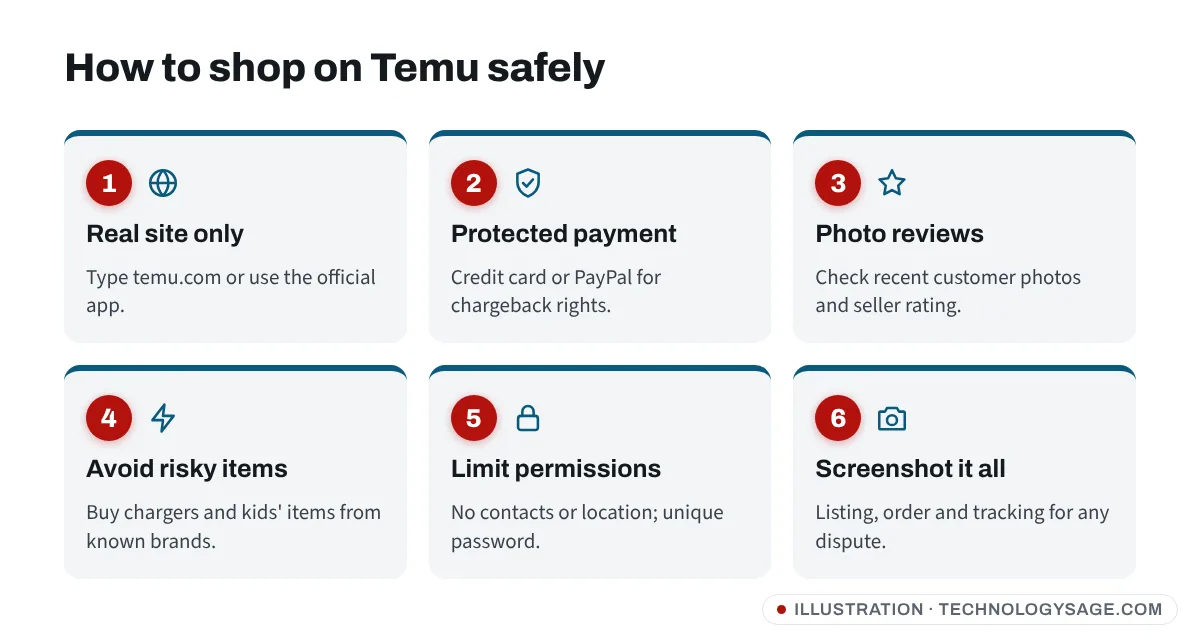
- Use the real site or app. Type temu.com or install the app from the App Store or Google Play. Don’t follow ads or texts with deals that seem impossible even for Temu.
- Pay with a method that has chargeback rights. A credit card gives the strongest protection. In the US, the Fair Credit Billing Act lets you dispute charges for goods not delivered as agreed (generally within 60 days of the statement). In the UK, Section 75 covers credit card purchases between £100 and £30,000, and the card chargeback scheme covers smaller ones. Where they’re offered at checkout, PayPal, Apple Pay and Google Pay also keep your card number away from the seller. Avoid debit cards linked to your main account, gift cards and bank transfers.
- Read reviews with photos. Sort by recent, look at customer pictures and check the seller’s rating before buying.
- Be careful with safety-critical items. Buy chargers, power banks, electric heaters, car seats, helmets and toys for small children from established brands and retailers instead.
- Limit app permissions. If you use the app, don’t allow contacts, precise location or notifications you don’t need. Use a unique password and turn on two-step verification if your account offers it.
- Screenshot everything. Save the listing, order confirmation and tracking. If an item is wrong or doesn’t arrive, request a return in Your orders first; if Temu refuses or stalls, open a dispute with your card issuer or PayPal.
For a lost order or refund problem, contact Temu only through the app or website. Ignore “Temu support” phone numbers in search ads or social media posts, and never give anyone remote access to your phone, your password or a one-time code.
Verdict: who should (and shouldn’t) shop on Temu
Temu suits you if you want cheap, low-stakes items (phone cases, storage boxes, craft supplies, kitchen gadgets, party decorations), can wait for delivery, and pay with a credit card or PayPal. For those things it mostly works as advertised, and the 90-day return window is more generous than many retailers’.
Skip it, or buy elsewhere, if you need something by a certain date, want reliable sizing or quality, or are buying electronics, chargers, cosmetics or children’s products where safety testing matters. And if you’re uncomfortable with how much data a shopping app collects, use the website rather than the app, or don’t use it at all. The same thinking applies to any free service: check which trackers a site uses and what you’re giving up for the low price.
FAQ
Is Temu safe to use with a credit card?
Generally yes, if you’re on the real temu.com or the official app. A credit card gives you chargeback rights if an order doesn’t arrive or isn’t as described. PayPal, Apple Pay or Google Pay add a layer, because the card number isn’t shared with the seller.
Is Temu a Chinese company?
Temu is owned by PDD Holdings, which was founded in China and also runs China’s Pinduoduo app. PDD lists Dublin as its principal executive office, and Temu’s US arm is Whaleco Inc., but its roots, much of its management and most of its sellers are in China.
Does Temu actually refund you?
Usually, yes. Most items can be returned within 90 days, the first return per order is free, and you can choose a refund to Temu credit or your original payment method. If a refund doesn’t arrive, keep your screenshots and contact your card issuer or PayPal.
Why is Temu so cheap?
It sells mostly direct from manufacturers, works on thin margins at huge scale, spends heavily on discounts to win customers, and many products are unbranded and made to a low price. Changes to US import rules in 2025 pushed some prices up.
Is the Temu free gift real?
Temu does run real promotions inside its own app, but texts, emails and social posts promising free gifts that ask for a shipping or customs fee are scams. Temu says it doesn’t ask for extra fees for gifts by message. Open the app yourself to check any offer.