In this guide
The Starlink Mini is Starlink’s small, portable satellite dish. It weighs 1.1kg, has the Wi-Fi router built in, and uses only 25 to 40 watts, so it can run from a power bank, a car socket or a small solar setup. In mid-2026 the kit cost about KSh 27,000 in Kenya, ₦318,000 in Nigeria and GHS 2,200 in Ghana, plus a monthly plan. In the US, the price has been cut several times since its $599 launch in 2024.
Is it worth it? Yes, if you need internet that moves with you (travel, fieldwork, a second home, a backup for power-cut-prone areas) or if mobile data is weak where you live. If you just want home internet in one place, the Starlink Standard is usually faster for a similar or slightly higher kit price.
Pros and cons
Pros
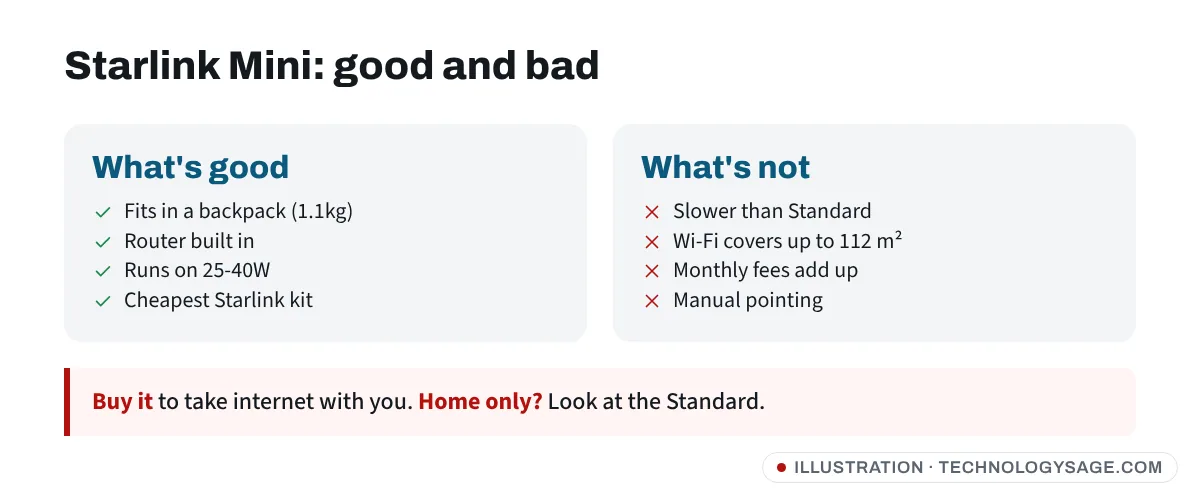
- Small and light: about the size of a laptop, 1.1kg without the kickstand
- Built-in Wi-Fi 5 router, so there’s no separate box to power
- Low power draw (25-40W average) and 12-48V DC input, so it runs from batteries and car power
- Can run from a USB-C power bank that supplies 100W (with Starlink’s USB-C cable accessory)
- IP67 rated when the DC cable and Starlink plug are fitted
- Cheapest Starlink kit in most African markets
Cons
- Slower than the Standard dish, especially uploads and in crowded areas
- Smaller Wi-Fi coverage (up to 112 m²) than the Standard’s router
- You must point it yourself (the app guides you); it doesn’t self-align
- Monthly plans can cost as much as or more than the kit over a year
- Not sold in every country (South Africa still has no service, for example)
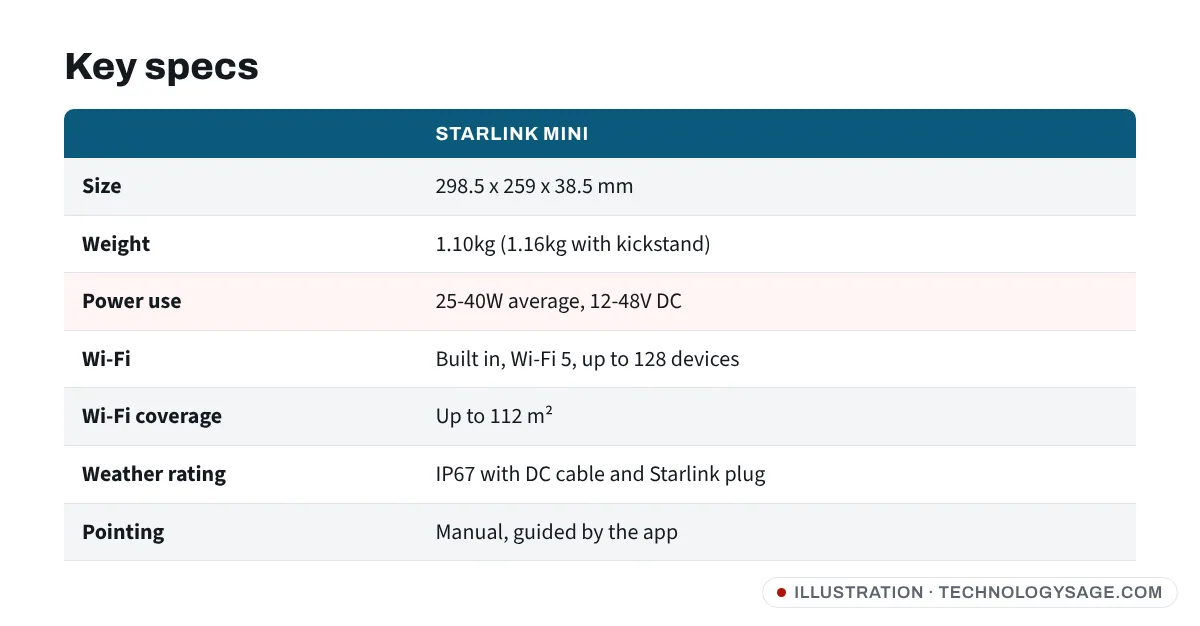
Starlink Mini specs
From Starlink’s official specification sheet.
| Spec | Starlink Mini |
|---|---|
| Size | 298.5 x 259 x 38.5 mm |
| Weight | 1.10kg; 1.16kg with kickstand; 1.53kg with kickstand and 15m cable |
| Field of view | 110° |
| Pointing | Manual, guided by the Starlink app |
| Power use | 25-40W average |
| Power input | 12-48V DC, 60W max; USB-C PD 100W (20V/5A) with Starlink’s USB-C cable accessory |
| Wi-Fi | Built in, Wi-Fi 5, dual band, up to 128 devices |
| Wi-Fi coverage | Up to 112 m² (1,200 sq ft) |
| Weather rating | IP67 (with DC cable and Starlink plug installed) |
| Operating temperature | -30°C to 50°C |
| Snow melt | Up to 25mm per hour |
| In the box (Mini X kit) | Dish, kickstand, pipe adapter and flat mount, 15m DC cable, power supply, Starlink plug, Router Mini |
One detail matters for anyone in hot or dusty places: Starlink notes the Mini is no longer rated IP67 if you plug in a standard RJ45 Ethernet cable. Use Starlink’s own Mini Ethernet cable or adapter if you need wired internet outdoors.
Some kits, sold as Mini X, also include a separate Router Mini (Wi-Fi 6, up to 120 m² and 235 devices). Check the box contents on the Starlink page for your country.
What’s good
It really is portable
At 1.1kg, the Mini fits in a backpack. Because the router is built in, setup is: unfold the kickstand, plug in power, open the Starlink app and follow the pointing guide. That makes it practical for road trips, field teams, events and moving between a city flat and a rural home.
It runs on very little power
25 to 40 watts is low enough for a laptop-style power bank, a car’s 12V socket or a small solar and battery system. That’s a big deal in places with frequent power cuts. A 100W USB-C PD power bank can run it, with Starlink’s USB-C to barrel-jack cable accessory.
Speeds are good enough for most people
Starlink doesn’t promise exact speeds, and results depend on your location, sky view and how busy the network is. Published reviews give a rough idea: HighSpeedInternet’s reviewer measured about 112 Mbps download, 11 Mbps upload and 20ms latency over Wi-Fi. A side-by-side test by EarthSims at 38 locations averaged 112 Mbps for the Mini vs 138 Mbps for the Standard. That’s plenty for video calls, streaming and online classes. For gaming, see how much internet speed you need for gaming.
What’s not so good
- Slower than the Standard. The Standard has a bigger antenna and was about 20% faster in EarthSims’ test, with some reviewers seeing a larger gap.
- Smaller Wi-Fi range. The built-in router covers up to 112 m². For a bigger house, add a Starlink mesh router.
- You pay every month. The kit is only part of the cost. Over a year, plan fees can be several times the kit price.
- Pointing matters. Trees, buildings and walls block the signal. You need a clear view of the sky.
Starlink Mini price by country
Starlink changes prices often, and prices depend on your address. The figures below come from Starlink’s local pricing as reported by tech.africa (checked 16 June 2026) and Philippine and US news coverage. Always check the current price on starlink.com before you pay.
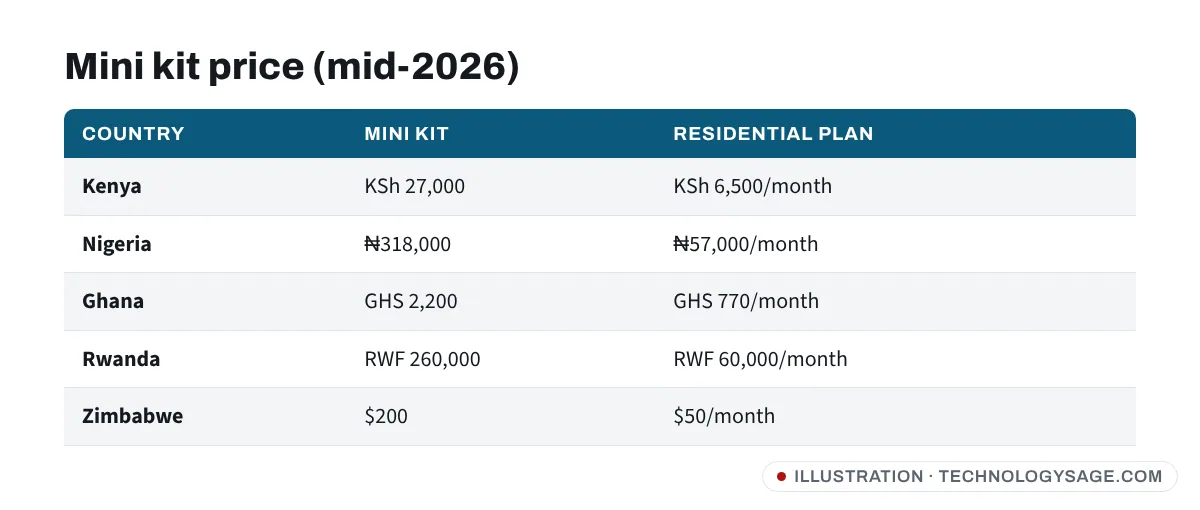
| Country | Mini kit | Residential plan | Residential Lite |
|---|---|---|---|
| Kenya | KSh 27,000 | KSh 6,500/month | KSh 4,000/month |
| Nigeria | ₦318,000 | ₦57,000/month | Not offered |
| Ghana | GHS 2,200 | GHS 770/month | GHS 500/month |
| Rwanda | RWF 260,000 | RWF 60,000/month | RWF 40,000/month |
| Zambia | ZMW 5,250 | ZMW 1,160/month | ZMW 800/month |
| Zimbabwe | $200 | $50/month | $30/month |
Kenya also has an instalment option for kits that Starlink introduced in January 2026, with reports of KSh 6,750 upfront for the Mini.
Philippines: Starlink raised prices in 2026. Reported Roam (portable) plans are about ₱3,299 a month for 100GB and ₱5,999 for unlimited. Check starlink.com for the current Mini kit price.
United States: the Mini launched at $599 in 2024. It has since been cut several times, to $199 for much of 2026 and to $149 in an October 2026 report. Roam plan prices also changed in 2026. US prices move quickly, so treat any number you read (including ours) as a guide only.
South Africa: Starlink service is still not available.
Mini 2: in November 2026, reports said Starlink was taking preorders for a Mini 2 with a swappable battery, first sold as a $999 launch bundle in the US. Details and availability elsewhere are not confirmed.
Which plan should you use with a Mini?
- Residential or Residential Lite if you’ll use it mainly at one address. In some markets this works out cheaper.
- Roam if you travel or move it between places. Roam plans let you use Starlink away from your home address, within limits set in Starlink’s terms.
If you’re unsure, our guide to finding a reliable internet provider can help you compare Starlink with fibre and mobile options where you live.
How to buy safely
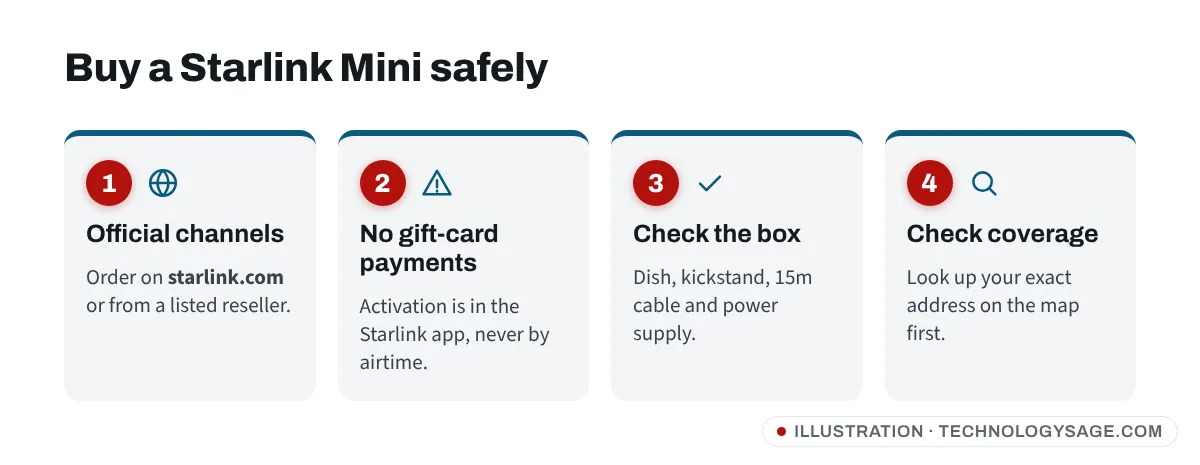
- Order on starlink.com or from an authorised reseller listed by Starlink. Social media “Starlink agents” have taken payments and disappeared.
- Never pay for activation by gift card, airtime or mobile money to a private number. Starlink activation is done in the Starlink app or on your Starlink account.
- Check the kit includes the 15m cable and power supply before you leave the shop.
- Look at the coverage map on starlink.com for your exact location first.
Should you buy the Starlink Mini?
Buy it if you travel, work in the field, run a small business that can’t go offline, or live where mobile data is unreliable and power cuts are common. The low power draw is the Mini’s big advantage.
Skip it if you only need internet at home in one place and have mains power. The Standard kit gives faster speeds and better Wi-Fi coverage; see our Starlink Mini vs Standard comparison. If your problem is weak Wi-Fi rather than no internet, try our Wi-Fi connected but no internet fixes first.
FAQ
How much is the Starlink Mini in Kenya?
About KSh 27,000 for the kit in mid-2026, with an instalment option. Residential plans were KSh 6,500 a month and Residential Lite KSh 4,000 a month. Check starlink.com for current prices.
How much is the Starlink Mini in Nigeria?
About ₦318,000 for the kit, with the Residential plan at ₦57,000 a month, based on Starlink’s mid-2026 prices.
Can the Starlink Mini run on a power bank?
Yes, if the power bank supplies USB-C Power Delivery at 100W (20V/5A) and you use Starlink’s USB-C to barrel-jack cable. It can also run from 12-48V DC sources such as a car socket.
Does the Starlink Mini need a separate router?
No. The Wi-Fi 5 router is built into the dish. Some Mini X kits add a separate Router Mini for better range.
How fast is the Starlink Mini?
Starlink doesn’t guarantee speeds. Published reviews have measured around 110-130 Mbps download and 10-20 Mbps upload, with roughly 20-50ms latency, depending on location.