In this guide
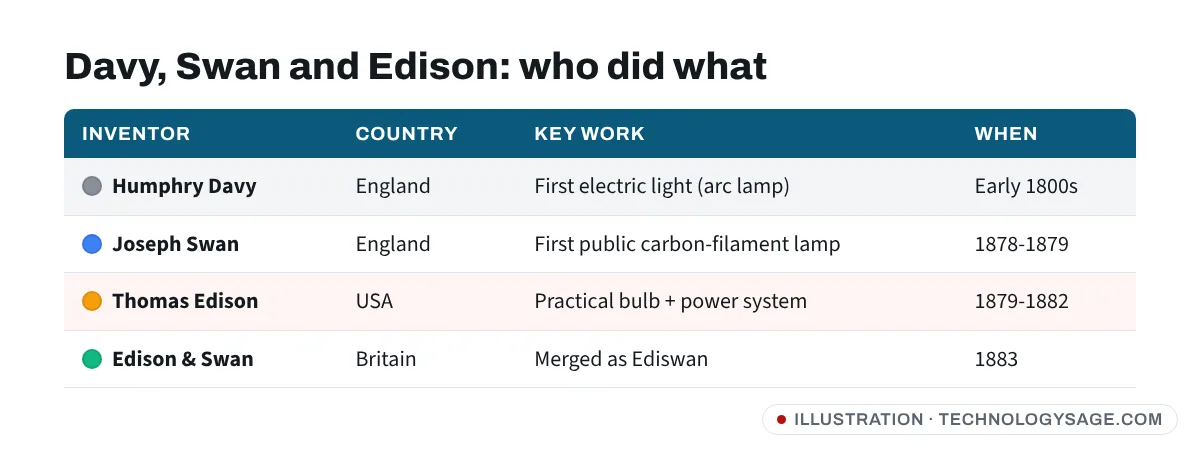
No single person invented the light bulb. Humphry Davy showed in the early 1800s that electricity could make light, dozens of inventors built short-lived electric lamps over the next 70 years, and then Joseph Swan in England and Thomas Edison in the United States each produced a working carbon-filament bulb around 1878-1880.
Edison usually gets the credit because he made the first bulb that was practical, long-lasting and commercially successful, and, just as importantly, built the power stations, wiring and meters needed to light whole streets and homes. Swan demonstrated his lamp publicly first, and in Britain the two men ended up running a joint company.
Who invented the light bulb first?
It depends on what you count as a “light bulb”:
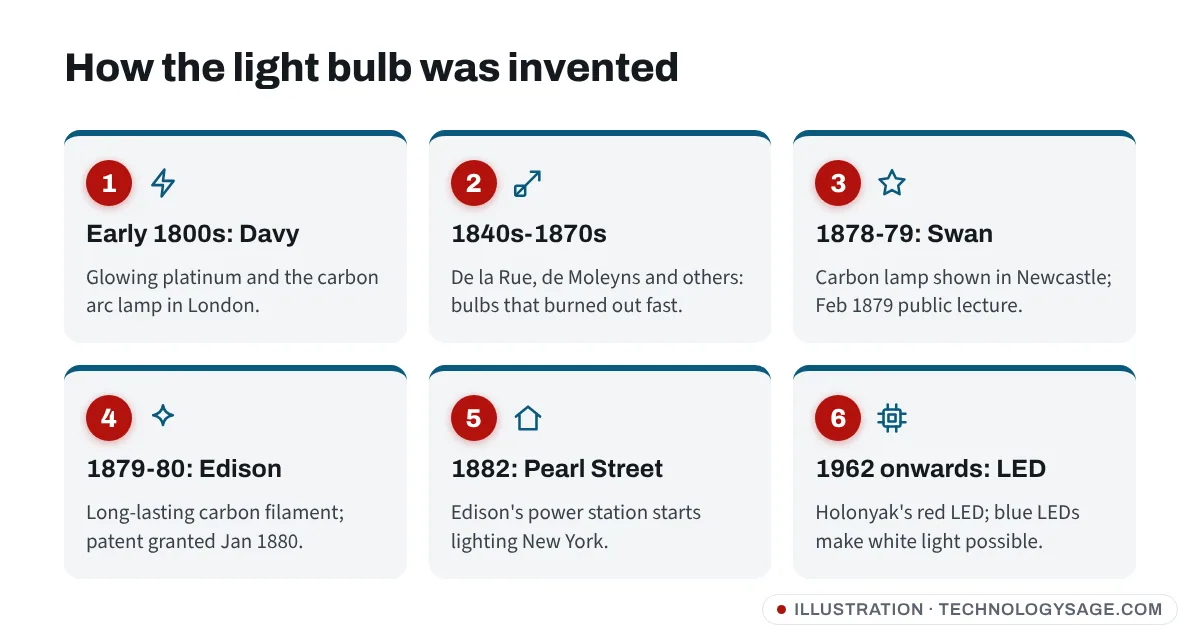
- The first electric light: Humphry Davy, at the Royal Institution in London in the early 1800s. He made strips of platinum glow with current from a large battery and demonstrated a bright arc lamp, where light jumps between two carbon rods. Arc lamps were later used for lighthouses and streets, but they were far too bright, hot and power-hungry for a living room.
- The first incandescent lamps in a glass bulb: several inventors in the 1840s-1870s, including Warren de la Rue (a platinum coil in a tube) and Frederick de Moleyns, who received a British patent in 1841 for a lamp in a glass bulb. These worked, briefly, but platinum was very expensive and the filaments burned out quickly because the vacuum pumps of the day could not remove enough air.
- The first practical carbon-filament bulb: Joseph Swan and Thomas Edison, working separately, in 1878-1880.
So “Davy” is a fair answer to who made the first electric light, and “Swan and Edison” is the fair answer to who made the first light bulb people could actually use.
Did Edison invent the light bulb?
Not from scratch, and he never claimed to have invented the idea of electric light. What Edison and his team at Menlo Park, New Jersey did was solve the problems that had stopped everyone else:
- A high-resistance filament. Edison realised a thin, high-resistance filament would need less current, so copper wires to homes could be much thinner and cheaper. That made a citywide system affordable.
- A better vacuum. Improved vacuum pumps removed far more air from the bulb, so the filament did not burn up.
- Endless testing. The team tried thousands of materials. In October 1879 a carbonised cotton thread glowed for over 13 hours; later bulbs used carbonised bamboo and lasted far longer.
- A patent. Edison filed for an “Electric Lamp” with a carbon filament in November 1879. US patent No. 223,898 was granted on 27 January 1880.
- The system around the bulb. This is the part often forgotten: generators, underground cables, fuses, sockets, switches and electricity meters. Edison’s Pearl Street Station in New York began supplying customers in 1882.
Edison also did not work alone. Engineers such as Francis Upton and Charles Batchelor did much of the experimental work at Menlo Park. Lewis Latimer, a Black American inventor and draughtsman, patented an improved method of making carbon filaments in the early 1880s while working for a rival lighting company, and later joined the Edison company as an expert in its patent cases.
What did Joseph Swan do?
Joseph Wilson Swan, a chemist from Sunderland and Newcastle upon Tyne, had been experimenting with carbon filaments since the 1850s. Once better vacuum pumps became available in the 1870s, his lamps finally worked.
- He showed his carbon lamp to audiences in Newcastle in December 1878 and, famously, to more than 700 people at the Literary and Philosophical Society of Newcastle on 3 February 1879, months before Edison’s successful test.
- Mosley Street in Newcastle became one of the first streets anywhere lit by incandescent electric lamps, around 1879-1880.
- Swan’s lamps lit the Savoy Theatre in London in 1881, the first public building lit entirely by electricity.
Swan’s early bulbs used a thicker, low-resistance filament, which needed heavy current. Edison’s thin, high-resistance design was better suited to a power network, and later Swan bulbs adopted improved filaments too.
Edison vs Swan: why they merged
When Edison’s company moved into Britain, it faced Swan’s British patents and a strong case that Swan had got there first. Rather than fight a long court battle, the two sides joined forces. In 1883 they formed the Edison and Swan United Electric Light Company, widely known as Ediswan, which made bulbs for the British market.
What did Thomas Edison invent?
Edison held more than 1,000 US patents, many shared with his team. Beyond the light bulb system, his best-known work includes:
- The phonograph (1877), the first machine that could record and play back sound. This was a genuinely new invention and made him famous.
- Improvements to the telegraph and telephone, including multiplex telegraph systems and a better carbon microphone transmitter.
- Electric power distribution: the direct current (DC) generators, cables and meters behind Pearl Street Station.
- Motion pictures: the Kinetograph camera and the Kinetoscope viewer, developed with his assistant William Kennedy Laurie Dickson.
- Batteries, including a nickel-iron storage battery.
His real innovation was arguably the industrial research lab itself: a team of paid inventors working on problems to order.
Tesla vs Edison: who was right?
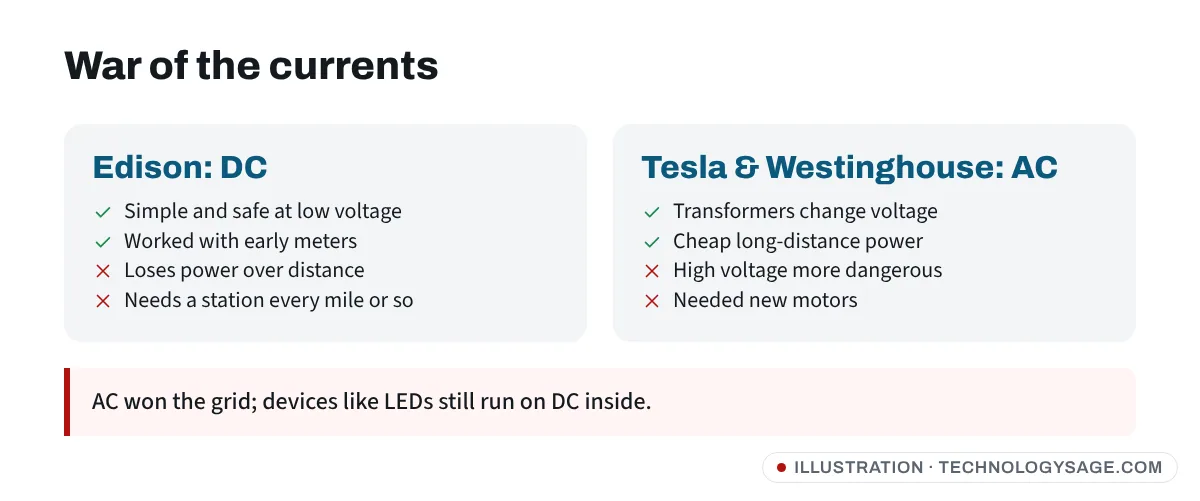
Nikola Tesla did not invent the light bulb, but he is often mentioned alongside Edison because of the “war of the currents” in the late 1880s:
| Edison | Tesla (with Westinghouse) | |
|---|---|---|
| Current type | Direct current (DC) | Alternating current (AC) |
| Strength | Simple, safe at low voltage, worked with early motors and meters | Voltage can be stepped up and down with transformers, so power travels long distances cheaply |
| Weakness | Needed a power station every mile or so | High voltages more dangerous, needed new motors |
| Outcome | Lost for power grids | Became the standard for grids worldwide |
Tesla briefly worked for Edison’s company in New York in 1884 before leaving to develop his AC induction motor, later licensed to George Westinghouse. AC won for the grid, but DC never went away: your phone charger, laptop and every LED bulb run on DC internally.
How the light bulb changed after Edison
- 1900s-1910s: tungsten filaments. Tungsten survives much higher temperatures than carbon, so bulbs became brighter and more efficient. William Coolidge at General Electric worked out how to draw tungsten into fine wire, and Irving Langmuir found that filling bulbs with inert gas made them last longer.
- 1930s onwards: fluorescent tubes for offices and factories, followed by compact fluorescent lamps (CFLs) for homes.
- 1962: the first visible-light LED, a red one, by Nick Holonyak Jr at General Electric.
- 1990s: bright blue LEDs, which made white LED lighting possible. Isamu Akasaki, Hiroshi Amano and Shuji Nakamura won the 2014 Nobel Prize in Physics for that work.
Today, many countries have restricted or phased out traditional incandescent bulbs on energy-efficiency grounds, and LEDs dominate. If you are curious about what goes into them, our guide to LED aluminium PCB substrates explains the boards that keep LED chips cool, and how to connect solar panels to a battery and inverter shows how DC from panels becomes the AC that Tesla championed.
Common myths about the light bulb
- “Edison invented electric light.” Electric light (arc lamps) existed decades before him.
- “Edison tried 10,000 materials and failed 10,000 times.” The team did test thousands of materials, but the exact numbers in famous quotes are not reliable.
- “Swan copied Edison” or “Edison stole from Swan.” Both worked independently on the same problem, which is common in invention history. Their companies merged rather than fight in court.
- “Tesla invented the light bulb.” He did not; his big contributions were AC motors and power systems, plus work on wireless power and radio.
For another example of a technology with many inventors and one famous name, see the history of Android phones.
FAQ
Who invented the light bulb first, Edison or Swan?
Swan demonstrated a working carbon-filament lamp first, in Newcastle in late 1878 and February 1879. Edison’s successful test came in October 1879, and his patent was granted in January 1880. Edison’s design and power system were the first to succeed commercially on a large scale.
Did Edison actually invent the light bulb?
He invented a practical, long-lasting version and the electrical system that made it useful, but electric lamps existed before him. “Improved and commercialised” is more accurate than “invented”.
Who made the first electric light?
Humphry Davy, in London in the early 1800s, with glowing platinum strips and the carbon arc lamp.
What was Edison’s light bulb filament made of?
His first long-burning test used carbonised cotton thread. Commercial Edison lamps of the 1880s used carbonised bamboo, before tungsten replaced carbon in the early 1900s.
Who invented the LED light bulb?
Nick Holonyak Jr made the first visible-light LED in 1962. White LED bulbs became practical after the blue LED work of Akasaki, Amano and Nakamura in the late 1980s and 1990s.