
In this guide
Customer support is an essential part of sales success. Fast, friendly answers help companies win new buyers and keep existing ones, while slow or confusing support quietly drives customers to competitors. Outsourcing customer support to a specialist provider can help, and it removes the need to hire and train a large in-house team, so business owners can focus on their core work.
This guide is for founders, managers and small business owners who are deciding whether to outsource support. It covers the main advantages, the drawbacks to watch out for, and how to choose and manage a provider.
What is customer support outsourcing?
Customer support outsourcing means hiring an external company to handle some or all of your customer interactions: phone calls, email, live chat, social media messages and technical help desk tickets. The provider’s agents answer on your behalf, usually using your brand name, your knowledge base and your support software or theirs.
Businesses outsource in different ways:
- Full outsourcing, where the provider runs the whole support function.
- Overflow or after-hours support, where your own team handles business hours and the provider covers nights, weekends or peak seasons.
- Specialised tiers, such as outsourcing first-line questions while keeping complex technical issues in-house.
The main advantages of outsourcing customer support
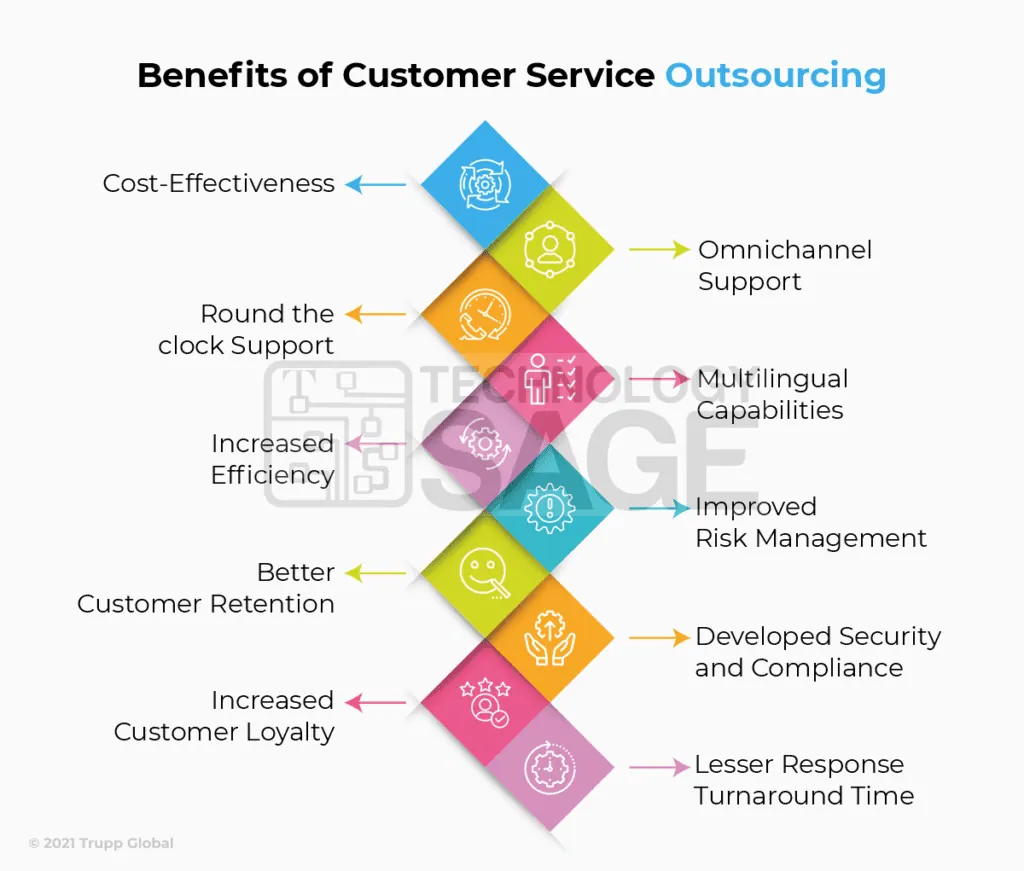
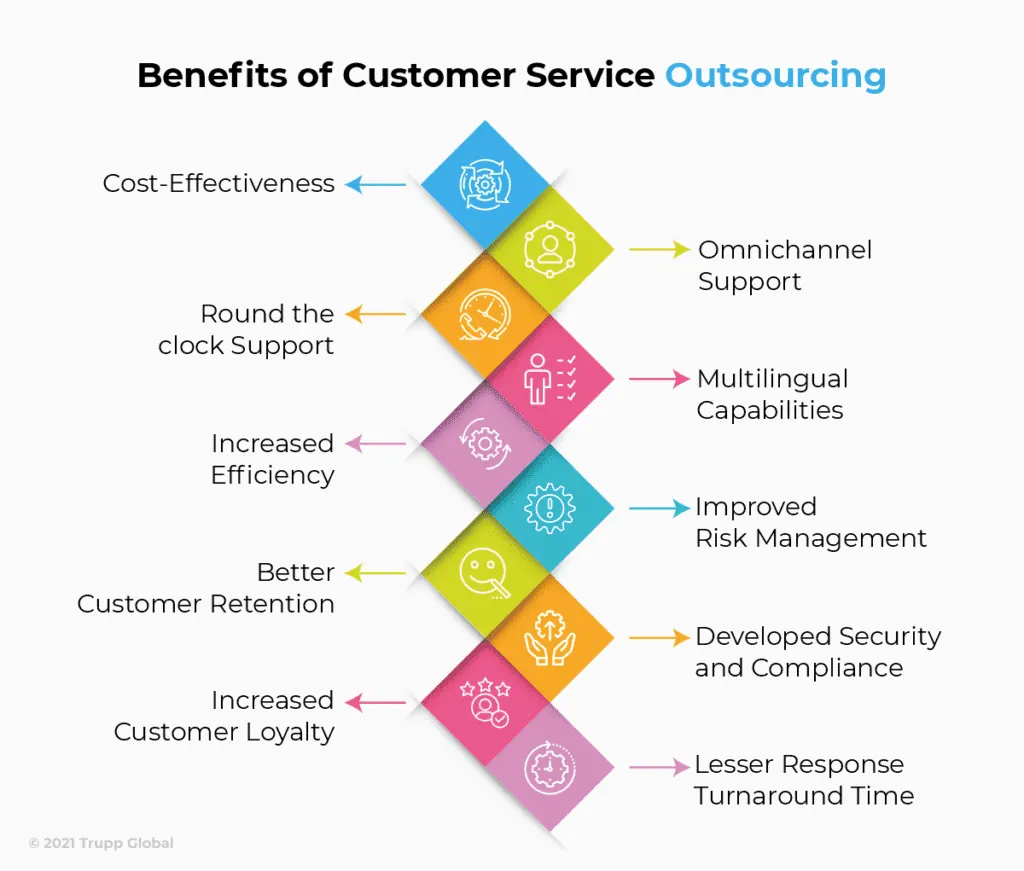
1. It is cost-effective
Customer support outsourcing is cost-effective (no longer available) for many businesses. Instead of paying for recruitment, salaries, benefits, office space, equipment and software licences for a full team, you pay the provider for the coverage you need. Providers spread their costs across many clients, which usually makes each hour of support cheaper than building the same capacity yourself.
Outsourcing to regions with lower labour costs can reduce expenses further. It also allows companies to recruit experienced support professionals and pay them fairly while still spending less than they would in their home market. This is especially useful for companies with a limited budget and frees up money for product development, marketing or sales.
2. Round-the-clock coverage
Customers expect help when they need it, not only during office hours. Outsourced companies have the staff and shift systems to offer 24/7 services across time zones. Long on-hold times, incomplete product information and delayed responses all turn customers off, and a provider with proper coverage can reduce all three.
3. Access to specialist expertise
Many providers specialise in technical support, so their agents already know how to troubleshoot a wide range of technical issues. This makes outsourcing a strong option for companies that sell software, electronics or other technical products. Providers also bring experience with support tools, ticketing systems, call routing and reporting that a small company may not have.
4. Easy scaling
Ticket volumes rarely stay flat. Product launches, holiday sales and outages can multiply contacts overnight. An outsourced team can add or remove agents far faster than you could hire and train new employees, so businesses can grow, expand into new markets and handle seasonal peaks without adding permanent staff.
5. More focus on your core business
When someone else handles the daily flow of password resets, order-status questions and basic troubleshooting, your managers and product team can spend their time on strategy, product quality and growth.
6. Multilingual support
Expanding into new countries often means supporting customers in their own language. Larger providers can offer agents who speak several languages, which is far easier than recruiting native speakers for every market yourself.
The drawbacks to consider
Outsourcing is not right for every business. Some companies find it easier to manage support themselves, for example by hiring part-time employees. Common concerns include:
- Less direct control over how each conversation is handled.
- Product knowledge gaps, especially for complex or fast-changing products.
- Brand voice and culture, which can be harder to maintain with an external team.
- Data protection. The provider will handle customer personal data, so you need a proper data processing agreement and must comply with the privacy laws that apply to you, such as Kenya’s Data Protection Act or the GDPR for European customers.
- Communication overhead, because you still need to brief, train and review the provider.
A company with high ticket volumes may benefit greatly from outsourcing to a provider with a larger team. If your volumes are small, you may still benefit from a provider’s knowledge and tools on a part-time or overflow basis rather than a full contract.
How to keep quality high
A healthy support operation relies on quality assurance. If you want your service to remain high-quality, make sure the support team, in-house or outsourced, is equipped with the right tools and information.
Outsourced support can actually improve the customer experience by introducing a structured process. To get there:
- Set minimum quality standards. Define response times, resolution targets and customer satisfaction goals in the contract.
- Train the team properly. Run onboarding sessions and role-plays based on real customer scenarios.
- Build a shared knowledge base. Create standardised documents, policies and answer templates, and keep them up to date as your product changes.
- Write clear escalation rules. Agents should know exactly when and how to pass an issue to your internal team.
- Review regularly. Listen to call recordings, read ticket samples and meet the provider monthly to discuss results and improvements.
How to choose a customer support outsourcing provider
While outsourced services offer many benefits, research each provider carefully so that the expectations of both parties are clear from the start. This helps prevent misunderstandings later. When comparing providers, ask about:
- Experience with businesses in your industry and with products like yours.
- The channels they support (phone, email, chat, social media) and the hours they cover.
- How they recruit, train and retain agents.
- Security practices and how they protect customer data.
- The reporting they provide and how often.
- Pricing models, such as per agent, per hour or per ticket.
Consider the type of contract carefully before signing. A short pilot or trial period is a sensible way to test the fit. You may also want to look at a bundled service package to make sure you are getting the most value for your money.
Frequently asked questions
Is outsourcing customer support suitable for small businesses?
Yes, often. Small businesses can use overflow, after-hours or part-time plans to get professional coverage without hiring a full team.
Will customers know the support is outsourced?
Usually not, if the provider is trained well and uses your brand name, tone and knowledge base.
Which support tasks are best to outsource?
Repetitive, well-documented questions such as order tracking, account access and basic troubleshooting are easiest. Complex, sensitive or high-value issues are often kept in-house.
How do I measure whether outsourcing is working?
Track response time, resolution time, customer satisfaction scores, repeat contacts and cost per ticket, and compare them with your figures before outsourcing.