In this guide
I had bought a netbook that I had been using with no problems. Then I decided to install Windows 8 on it and immediately came across a glitch. Whenever I tried to open certain apps, such as the Windows Store, the PDF reader, Photos and Maps, I got this error message: “Resolution too low to run this app. Change your screen resolution.”
This was quite annoying, so I went hunting for a solution. The hunt was not in vain: I found a workaround, and the apps now work with no errors. Before trying it, the highest screen resolution available on my netbook was 1024 x 600, while these apps require at least 1024 x 768.
This guide explains why the error appears, the registry workaround that fixes it on Windows 8 and 8.1, what can go wrong and what to do if you are on a newer version of Windows.

Important: which versions of Windows this applies to
This method was written for Windows 8 and Windows 8.1. Both versions are no longer supported by Microsoft, which means they no longer receive security updates, and the original Windows Store for these versions is no longer a reliable source of apps.
- If you are still on Windows 8 or 8.1: the steps below should still work, but consider upgrading to a supported version of Windows or, if your netbook cannot run one, a lightweight supported operating system.
- If you are on Windows 10 or Windows 11: this specific error from Windows 8 is not normally seen. If an app looks cut off on a small screen, go to Settings > System > Display, check the resolution, and try lowering the Scale setting so more fits on the screen.
Why the error appears
Windows 8 introduced full-screen “Modern” apps (also called Metro apps) that required a screen of at least 1024 x 768 pixels. Many netbooks had screens of 1024 x 600, which is 168 pixels short vertically. Windows therefore refused to open these apps, even though ordinary desktop programs worked fine.
The registry setting below tells the graphics driver to allow downscaling: Windows renders a larger picture and shrinks it to fit your physical screen. This makes the apps open, but because the image is squeezed, text and images may look slightly blurry or stretched.
Before you start
- Sign in with an administrator account. You need administrator rights to edit the registry.
- Back up the registry or create a restore point. The registry controls core Windows settings, and a wrong change can cause problems. In Registry Editor, you can choose File > Export to save a backup copy first.
- Try updating your graphics driver first. A newer driver sometimes adds higher resolutions or fixes the problem. If you are not sure how, check out this video on how to update drivers. If the problem persists, follow the steps below.
How to fix “Resolution too low to run this app” in Windows 8
- Press Windows key + R to open the Run box.
- Type regedit and press Enter. If you are asked whether to allow the app to make changes, click Yes.
- Registry Editor opens. Be careful here, and only change the value described in these steps.
- Press Ctrl + F to open the Find box.
- In the Find what box, type Display1_DownScalingSupported and press Enter.
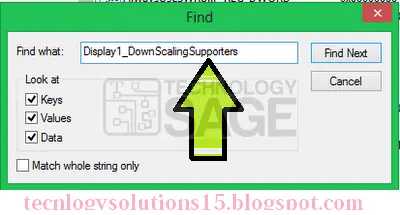
- The search finds an entry labelled Display1_DownScalingSupported. You need to change its value from 0 to 1.
- Double-click it, type 1 in the Value data field, and click OK.
- Press F3 to find the next matching entry. On some computers there is more than one. Change each one to 1, and repeat until Windows says the search is finished.
- Close Registry Editor and restart the computer. Registry changes like this usually only take effect after a restart.
- After the restart, right-click the desktop and choose Screen resolution. The list of available resolutions should now include options higher than 1024 x 600. Choose 1024 x 768 (or the highest option offered).
- Click Apply, then Keep changes.
That’s it. You can now enjoy the apps without worrying about screen resolution errors in Windows 8.
Troubleshooting
- The search finds nothing: your graphics driver may not support this setting. The value is usually created by the graphics driver, so not every computer has it. Try updating the driver and searching again.
- No higher resolution appears after restarting: make sure you changed every matching entry, not just the first one, then restart again.
- The screen looks stretched or blurry: this is expected with downscaling. Switch back to 1024 x 600 when you are using desktop programs, and use the higher resolution only for Modern apps.
- The screen goes black or shows “out of range”: wait about 15 seconds without clicking. Windows will revert to the previous resolution automatically if you do not confirm the change.
- You want to undo the change: open Registry Editor again, set each Display1_DownScalingSupported value back to 0, and restart. You can also double-click the backup file you exported earlier.
Frequently asked questions
Is it safe to edit the registry?
It is safe if you change only the value described here and back up first. Avoid changing other entries you are unsure about.
Will this damage my screen?
No. The physical screen still runs at its normal resolution. Windows simply shrinks a larger image to fit.
Does this fix work on Windows 10 or 11?
These versions do not normally show this error. Adjust resolution and scaling in Settings > System > Display instead.
Why do desktop programs work but Modern apps do not?
Windows 8 enforced a minimum resolution only for full-screen Modern apps. Traditional desktop programs had no such minimum.